Advertisements
Advertisements
प्रश्न
An object 5 cm high forms a virtual image of 1.25 cm high, when placed in front of a convex mirror at a distance of 24 cm. Calculate:
- the position of the image
- the focal length of the convex mirror.
Advertisements
उत्तर
Size of the object = h0 = 5 cm
Size of the image = h1 = +1.25 cm
Distance of the object from mirror = u = – 24 cm
Distance of the image from the mirror = v = ?
Focal length of the concave mirror = f = ?
(i) Magnification = m = `"h"_1/"h"_0 = - "v"/"u"`
`1.25/5 = (-"v")/-24`
v = `(24 xx 0.25)/5`
v = 24 × 0.25
v = 6 cm
(ii) Using mirror formula:
`1/"u" + 1/"v" = 1/"f"`
We have,
`1/-24 + 1/6 = 1/"f"`
`1/"f" = - 1/24 + 1/6 = (- 1 + 4)/24 = 3/24 = 1/8`
⇒ f = 8 cm
APPEARS IN
संबंधित प्रश्न
An image formed by a ______ mirror is always of the same size as that of the object.
A ray of light is incident on a plane mirror at an angle of 30°. What is the angle of reflection
State the kind of mirror used
(a) by a dentist, and
(b) as a street light reflector.
Figure shows a concave mirror with its pole at P, focus F and centre of curvature C. Draw ray diagram to show the formation of image of an object OA.
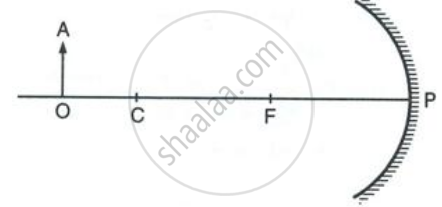
Write two more characteristics of the image.
For an incident ray directed towards centre of curvature of a spherical mirror the reflected ray:
The image formed by a convex mirror is of size one third the size of object. How are u and v related?
A concave mirror forms a real image of an object placed in front of it at a distance 30 cm, of size three times the size of object. Find
- the focal length of mirror
- position of image.
What do you understand by the term real image?
