Advertisements
Advertisements
प्रश्न
A concave lens produces an image 20 cm from the lens of an object placed 30 cm from the lens. The focal length of the lens is:
(a) 50 cm
(b) 40 cm
(c) 60 cm
(d) 30 cm
Advertisements
उत्तर
60 cm
Object distance from the lens, u =-30 cm
Image distance from the lens, v =-20 cm
Using the lens formula, we get:
`1/f=1/v-1/u`
`1/f=1/-20-1/-30`
`1/f=1/-20+1/30`
`1/f=(-3+2)/60=1/60`
∴ f =- 60 cm
Therefore, the focal length of the lens is 60 cm.
APPEARS IN
संबंधित प्रश्न
An image which can be obtained on a screen is called a ______ image.
Match the items given in Column I with one or more items of Column II.
| Column I | Column II | ||
| (a) | A plane mirror | (i) | Used as a magnifying glass. |
| (b) | A convex mirror | (ii) | Can form image of objects spread over a large area. |
| (c) | A convex lens | (iii) | Used by dentists to see enlarged image of teeth. |
| (d) | A concave mirror | (iv) | The image is always inverted and magnified. |
| (e) | A concave lens | (v) | The image is erect and of the same size as the object. |
| (vi) | The image is erect and smaller in size than the object. |
Find out the letters of English alphabet or any other language known to you in which the image formed in a plane mirror appears exactly like the letter itself. Discuss your findings.
When a spherical mirror is held towards the sun and its sharp image is formed on a piece of carbon paper for some time, a hole is burnt in the carbon paper.
- What is the nature of spherical mirror?
- Why is a hole burnt in the carbon paper?
- At which point of the spherical mirror the carbon paper is placed?
- What name is given to the distance between spherical mirror and carbon paper?
- What is the advantage of using a carbon paper rather than a white paper?
Draw suitable diagrams to illustrate the action of (i) concave mirror and (ii) convex mirror on a beam of light incident parallel to the principal axis.
Define the terms focus and focal length of a concave mirror. Draw diagram to illustrate your answer.
Name the kind of mirror used to obtain :
A real and enlarged image
Which mirror will you prefer to use as a rear view mirror in a car : plane mirror or convex mirror? Give one reason.
An object 5 cm high is placed at a distance 60 cm in front of a concave mirror of focal length 10 cm. Find the position and size of the image.
At what distance from a concave mirror of focal length 25 cm should an object be placed so that the size of image is equal to the size of the object.
An object forms a virtual image which is 1/8th of the size of the object. If the object is placed at a distance of 40 cm from the convex mirror, calculate:
- the position of the image
- the focal length of the convex mirror.
Select the correct option:
Looking into a mirror one finds her image diminished, the mirror is:
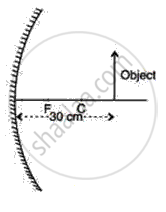
An object is placed in front of a concave mirror as shown in the following figure. By scale drawing, find the nature of the image. Given f = 10 cm, v = 30 cm.
For a spherical mirror, ______ is true.
The distance from the center of curvature of the mirror to the pole is called the focal length of the mirror.
