Advertisements
Advertisements
प्रश्न
An object forms a virtual image which is 1/8th of the size of the object. If the object is placed at a distance of 40 cm from the convex mirror, calculate:
- the position of the image
- the focal length of the convex mirror.
Advertisements
उत्तर
Let size of the object = h0 = x
Size of the image h1 = `"x"/8` = + 1.25 cm
Distance of the object from the converx mirror = u = - 40 cm
Distance of the image from the convex mirror = v = ?
(i) Magnification = m = `"h"_1/"h"_0 = - "v"/"u"`
`("x"/8)/"x" = - "v"/-40`
v = `"x"/"8x" xx 40 = 5` cm
(ii) Using mirror formula:
`1/"u" + 1/"v" = 1/"f"`
We have,
`1/-40 + 1/5 = 1/"f"`
`1/"f" = - 1/40 + 1/5`
`1/"f" = (- 1 + 8)/40 = 7/40`
⇒ f = `40/7 = 5.71` cm
APPEARS IN
संबंधित प्रश्न
One half of a convex lens of focal length 10 cm is covered with a black paper. Can such a lens produce an image of a complete object placed at a distance of 30 cm from the lens? Draw a ray diagram to justify your answer. A 4 cm tall object is placed perpendicular to its principal axis of a convex lens of focal length 20 cm. The distance of the object from the lens is 15 cm. Find the nature, position and the size of the image.
A ray of light is incident on a plane mirror at an angle of 30°. What is the angle of reflection
State the two convenient rays that are chosen to construct the image by a spherical mirror for a given object? Explain your answer with the help of suitable ray diagrams.
For an incident ray directed towards centre of curvature of a spherical mirror the reflected ray:
An object of length 4 cm is placed in front of a concave mirror at distance 30 cm. The focal length of mirror is 15 cm.
- Where will the image form?
- What will be the length of image?
Define the following term in relation to concave mirror.
Center of curvature
Define the following term in relation to concave mirror.
Focal length
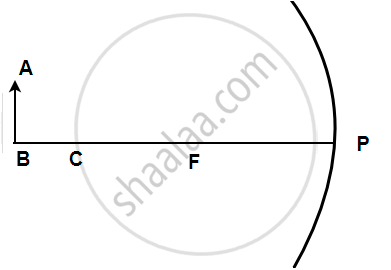
The following figure shows a concave mirror with its pole (P), focus (F), and center of curvature (C). Draw a ray diagram to show the formation of the image of an object AB by the concave mirror.
The image formed in a plane mirror is always inverted.
