Advertisements
Advertisements
प्रश्न
A ray of light is incident normally on a plane mirror. What will be the
angle of incidence?
Advertisements
उत्तर
The angle of incidence is 0o because the incident ray is parallel to the normal.
APPEARS IN
संबंधित प्रश्न
Explain the following term related to spherical lenses: focal length
An image that cannot be obtained on a screen is called ______.
A ray of light is incident on a plane mirror at an angle of 30°. What is the angle of reflection
What type of image is formed:
in a plane mirror?
When a spherical mirror is held towards the sun and its sharp image is formed on a piece of a carbon paper for some time, a hole is burnt in the carbon paper.
Why is a hole burnt in the carbon paper?
Write true or false
A virtual image formed by a spherical mirror is always erect and situated behind the mirror.
Define the following terms in the context of spherical mirrors :
(i) Pole
(ii) Centre of curvature
(iii) Radius of curvature
(iv) Principal axis
State the two convenient rays that are chosen to construct the image by a spherical mirror for a given object? Explain your answer with the help of suitable ray diagrams.
An object is placed at 4 cm distance in front of a concave mirror of radius of curvature 24 cm. Find the position of image. Is the image magnified?
Draw a ray diagram to show the formation of the image, when the object is placed between optical centre and principal focus of a convex lens.
State the signs and values of magnifications in the above mentioned case.
An object 5 cm high forms a virtual image of 1.25 cm high, when placed in front of a convex mirror at a distance of 24 cm. Calculate:
- the position of the image
- the focal length of the convex mirror.
Select the correct option:
A concave mirror is made by cutting a portion of a hollow glass sphere of radius 30 cm. The focal length of the concave mirror is:
Define the following term in relation to concave mirror.
Radius of curvature
In the following figure shows a concave mirror with its pole (P), focus (F) and centre of curvature (C). Draw a ray diagram to show the formation of the image of an object AB by the concave mirror.
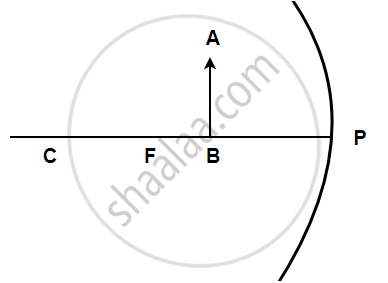
An object 10 cm high is placed at a distance of 20 cm in front of a spherical mirror of focal length 25 cm. By scale drawing find the nature, position, and magnification of the image in the following case:
Concave mirror
The diagram below shows the parallel rays incident on a convex mirror. C is the centre of the curvature of the mirror. By drawing the paths of the reflected rays, label the focus F and hence find the focal length of the mirror.
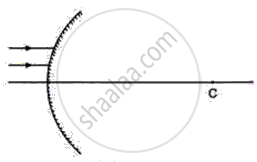
Geometric centre of the spherical mirror is ______.
Numerical problem.
The radius of curvature of a spherical mirror is 25 cm. Find its focal length.
A spherical mirror whose reflecting surface is curved outwards is called ______ mirror.
Define the following terms in the context of a diverging mirror:
- Principal focus
- Focal length
Draw a labelled ray diagram to illustrate your answer.
