Advertisements
Advertisements
Question
A concave mirror forms a virtual image of size twice that of the object placed at a distance 5 cm from it. Find:
- the focal length of the mirror
- position of image
Advertisements
Solution
Given: Object distance, u = −5 cm (object is in front of the mirror)
The image is virtual and erect
Magnification, m = +2m
(a) m = `-v/u`
∴ `-v/u = 2`
∴ −v = 2u
∴ −v = 2 × −5
∴ v = 10 cm
Hence, the image is 10 cm behind the mirror.
(b) From the mirror formula,
`1/f = 1/v + 1/u`
∴ `1/f = 1/10 + 1/(-5)`
= `1/10 - 1/5`
∴ f = −10 cm
APPEARS IN
RELATED QUESTIONS
Explain the following term related to spherical lenses:- centres of curvature
Name the spherical mirror which has:
(a) virtual principal focus.
(b) real principal focus.
Define (a) centre of curvature (b) radius of curvature (c) pole (d) principal axis, and (e) aperture, of a spherical mirror with the help of a labelled diagram
Name the kind of mirror used to obtain :
A real and enlarged image
How is the focal length of a spherical mirror related to its radius of curvature?
Define the following term in relation to concave mirror.
Focal length
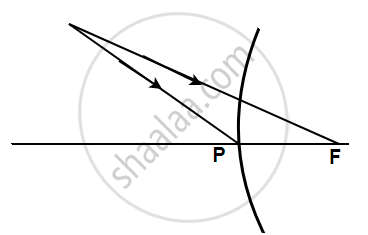
Complete the following diagrams shown in the following figures by drawing the reflected rays.
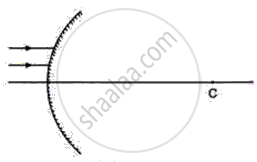
The diagram below shows the parallel rays incident on a convex mirror. C is the centre of the curvature of the mirror. By drawing the paths of the reflected rays, label the focus F and hence find the focal length of the mirror.
The radius of curvature of a spherical mirror is 18 cm. What is the focal length of this mirror?
