The Shiny Outer Surface of a Hollow Sphere of Aluminium of Radius 50 Cm is to Be Used as a Mirror: What Will Be the Focal Length of this Mirror?
Advertisements
Question
The shiny outer surface of a hollow sphere of aluminium of radius 50 cm is to be used as a mirror:
What will be the focal length of this mirror?
Advertisements
Solution
APPEARS IN
RELATED QUESTIONS
Explain the following term related to spherical lenses:- optical centre
Define the following term in the context of spherical mirrors:- Principal focus
What is a virtual image?
Which type of mirror can form a real image?
Name the spherical mirror which has:
(a) virtual principal focus.
(b) real principal focus.
Name the two types of spherical mirrors. What type of mirror is represented by the:
- back side of a shining steel spoon?
- front side of a shining steel spoon?
A lens forms a real image 3 cm high of an object 1 cm high. If the separation of object and image is 15 cm, find the focal length of the lens.
A 50 cm tall object is at a very large distance from a diverging lens. A virtual, erect and diminished image of the object is formed at a distance of 20 cm in front of the lens. How much is the focal length of the lens?
How is a spherical mirror used to diverge a beam of light from a point? Name the type of mirror used.
The letters on the front of an ambulance are written laterally inverted like  . Give reason.
Complete the following diagrams in Figure by drawing the reflected rays for the incident rays 1 and 2.
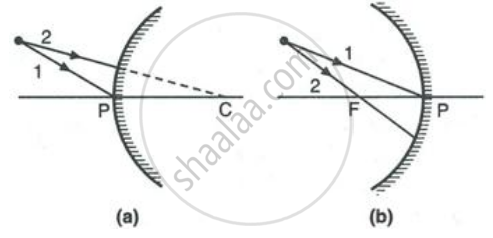
State the kind of mirror used
(a) By a dentist,
(b) As a search-light reflector.
An object is placed at 4 cm distance in front of a concave mirror of radius of curvature 24 cm. Find the position of image. Is the image magnified?
Define the following term:
concave mirror
Define the term Aperture.
Define the term Normal.
Assertion: Incident ray is directed towards the centre of curvature of spherical mirror. After reflection it retraces its path.
Reason: Angle of incidence (i) = Angle of reflection (r) = 0°
Define the radius of curvature.
