Advertisements
Advertisements
Question
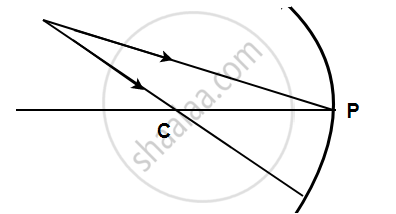
Complete the following diagrams shown in the following figures by drawing the reflected rays.
Advertisements
Solution

A light ray coming from a point on object AB is reflected from the surface of the mirror, it passes through the principal focus and the other ray passing through the center of curvature strikes the mirror normally i.e. 90 degrees. Hence it will reflect back. These two reflected rays coincide at a point where the image is formed. The image, A'B' is real, inverted, and diminished in size.
APPEARS IN
RELATED QUESTIONS
Define Radius of curvature of the spherical mirror
An optical device has been given to a student and he determines its focal length by focusing the image of the sun on a screen placed 24 cm from the device on the same side as the sun. Select the correct statement about the device.
(A) Convex mirror of focal length 12 cm
(B) Convex lens of focal length 24 cm
(C) Concave mirror of focal length 24 cm
(D) Convex lens of focal length 12 cm
A student obtained a sharp image of a burning candle, placed at the farther end of a laboratory table, on a screen using a concave mirror. For getting better value of focal length of the mirror, the subject teacher suggested him for focusing a well illuminated distant object. What should the student do?
(A) He should move the mirror away from the screen.
(B) He should move the mirror slightly towards the screen.
(C) He should move the mirror as well as the screen towards the newly selected object.
(D) He should move only the screen towards the newly selected object.
Define the following term:
spherical mirror
Define the following term in relation to concave mirror.
Aperture
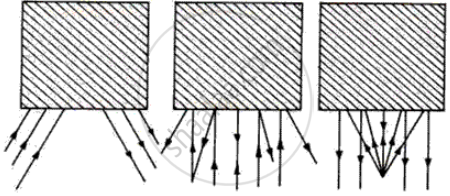
The boxes in figure (a, b, c) represent mirrors; insert a mirror which will reflect the incident ray as shown in the diagram.
A concave mirror can be used to produce a parallel beam of light. Draw a ray to illustrate this.
What is the difference between virtual images of an object formed by a concave mirror and a convex mirror?
