Advertisements
Advertisements
प्रश्न
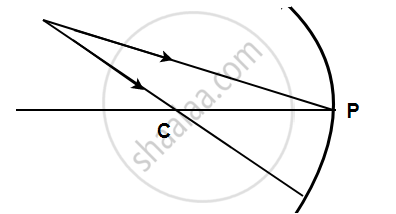
Complete the following diagrams shown in the following figures by drawing the reflected rays.
Advertisements
उत्तर

A light ray coming from a point on object AB is reflected from the surface of the mirror, it passes through the principal focus and the other ray passing through the center of curvature strikes the mirror normally i.e. 90 degrees. Hence it will reflect back. These two reflected rays coincide at a point where the image is formed. The image, A'B' is real, inverted, and diminished in size.
APPEARS IN
संबंधित प्रश्न
What happens when a ray of light falls normally (or perpendiculary) on the surface of a plane mirror?
What is the relation between the focal length and radius of curvature of a spherical mirror (concave mirror or convex mirror)?
When a spherical mirror is held towards the sun and its sharp image is formed on a piece of a carbon paper for some time, a hole is burnt in the carbon paper.
Why is a hole burnt in the carbon paper?
Name the spherical mirror which can produce a real and diminished image of an object.
The shiny outer surface of a hollow sphere of aluminium of radius 50 cm is to be used as a mirror:
What will be the focal length of this mirror?
Define the terms pole, principal axis and centre of curvature with reference to a spherical mirror.
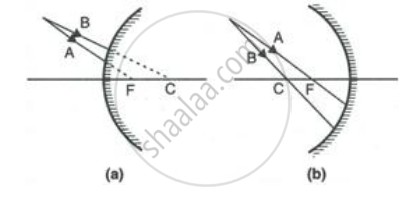
Complete the following diagrams shown in Fig. by drawing the reflected ray for each of the incident ray A and B.
An object 5 cm high is placed at a distance 60 cm in front of a concave mirror of focal length 10 cm. Find the position and size of the image.
The distance from the center of curvature of the mirror to the pole is called the focal length of the mirror.
