Advertisements
Advertisements
Question
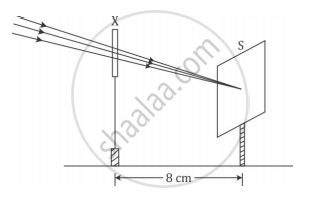
A student used a device (X) to obtain/focus the image of a well illuminated distant building on a screen (S) as shown below in the diagram. Select the correct statement about the device (X).
Options
This device is a concave lens of focal length 8 cm.
This device is a convex mirror of focal length 8 cm.
This device is a convex lens of focal length 4 cm.
This device is a convex lens of focal length 8 cm.
Advertisements
Solution
This device is a convex lens of focal length 8 cm.
Explanation:
The incident rays after passing through the lens converge at the focus. So, the device 'X' is a converging or a convex lens. The distance between the lens and the screen gives the focal length of the lens.
APPEARS IN
RELATED QUESTIONS
A simple microscope is used by watch repairers. Give reason.
Define the following term in the context of spherical mirrors:- Pole
Define the following term in the context of spherical mirrors:- Centre of curvature
What happens when a ray of light falls normally (or perpendiculary) on the surface of a plane mirror?
What is the relation between the focal length and radius of curvature of a spherical mirror (concave mirror or convex mirror)?
What do you understand by the focus and focal length of a spherical mirror? Show them on the separate diagrams for each of a concave mirror and a convex mirror.
A concave mirror forms a virtual image of size twice that of the object placed at a distance 5 cm from it. Find:
- the focal length of the mirror
- position of image
An object forms a virtual image which is 1/8th of the size of the object. If the object is placed at a distance of 40 cm from the convex mirror, calculate:
- the position of the image
- the focal length of the convex mirror.
