Advertisements
Advertisements
Question
Three mirrors are created from a single sphere. Which of the following - pole, centre of curvature, radius of curvature, principal axis - will be common to them and which will not be common?
Advertisements
Solution
Let us name the mirrors M1, M2 and M3 as shown below.
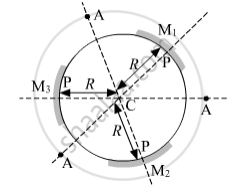
From the figure, we see that
- pole (P) is not common.
- centre of curvature (C) is common.
- principal axis (PA) is not common.
- radius of curvature (R) is common. The radius of curvature is the radius of the sphere. In the given figure, the length CP is the same for all mirrors.
APPEARS IN
RELATED QUESTIONS
What is the relation between the focal length and radius of curvature of a spherical mirror (concave mirror or convex mirror)?
When a spherical mirror is held towards the sun and its sharp image is formed on a piece of carbon paper for some time, a hole is burnt in the carbon paper.
- What is the nature of spherical mirror?
- Why is a hole burnt in the carbon paper?
- At which point of the spherical mirror the carbon paper is placed?
- What name is given to the distance between spherical mirror and carbon paper?
- What is the advantage of using a carbon paper rather than a white paper?
When a spherical mirror is held towards the sun and its sharp image is formed on a piece of a carbon paper for some time, a hole is burnt in the carbon paper.
Why is a hole burnt in the carbon paper?
A lens forms a real image 3 cm high of an object 1 cm high. If the separation of object and image is 15 cm, find the focal length of the lens.
- A small object is placed 150 mm away from a diverging lens of focal length 100 mm.
- Copy the figure below and draw rays to show how an image is formed by the lens.
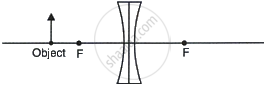
- Calculate the distance of the image from the lens by using the lens formula.
- Copy the figure below and draw rays to show how an image is formed by the lens.
- The diverging lens in part (a) is replaced by a converging lens also of focal length 100 mm. The object remains in the same position and an image is formed by the converging lens. Compare two properties of this image with those of the image formed by the diverging lens in part (a).
Write true or false
A virtual image formed by a spherical mirror is always erect and situated behind the mirror.
How is a spherical mirror used to converge a beam of light at a point? Name the type of mirror used.
State whether the image in part (a) is real or virtual?
What is meant by magnification? Write its expression. What is its sign for the (a) real (b) virtual, image?
State two uses of a concave mirror.
An object of height 2 cm is placed at a distance of 20 cm in front of a concave mirror of a focal length of 12 cm. Find the position, size, and nature of the image.
A straight stick partly dipped in water obliquely appears to be bent at the surface of the water.
The sun is seen before the sunrise and after the sunset.
Define linear magnification produced by a mirror?
Define the term Principle focus.
Spherical mirrors are one form of ______ mirrors.
Define the following terms in the context of a diverging mirror:
- Principal focus
- Focal length
Draw a labelled ray diagram to illustrate your answer.
