Advertisements
Advertisements
प्रश्न
Name the mirrors shown in Figure (a) and (b).
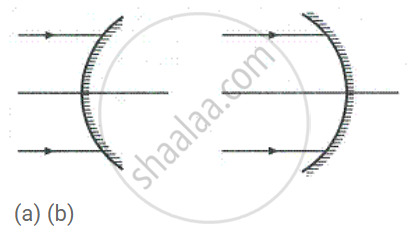
आकृती
एका वाक्यात उत्तर
Advertisements
उत्तर
(i) In figure (a) a convex mirror is shown.
In figure (b) a concave mirror is shown.
shaalaa.com
या प्रश्नात किंवा उत्तरात काही त्रुटी आहे का?
APPEARS IN
संबंधित प्रश्न
What is a virtual image?
A ray of light is incident normally on a plane mirror. What will be the:
- angle of incidence?
- angle of reflection?
Define (a) centre of curvature (b) radius of curvature (c) pole (d) principal axis, and (e) aperture, of a spherical mirror with the help of a labelled diagram
The magnification for a mirror is -3. How are u and v related?
The sun is seen before the sunrise and after the sunset.
For what position of an object, a concave mirror forms a real image equal in size to the object?
You can see the reflection of your clearly on a polished table-top is not polished. Explain.
Define the term Centre of curvature.
The distance from the pole to the focus is called ______.
A shopkeeper wanted to fix a mirror which will give a maximum view of his shop. What type of mirror should he use? Give reason.
