Advertisements
Advertisements
प्रश्न
Which of the following has curved reflecting surface?
विकल्प
plane mirrors
spherical mirrors
simple mirrors
None of the above
Advertisements
उत्तर
Spherical mirrors
APPEARS IN
संबंधित प्रश्न
Define the following term in the context of spherical mirrors:- Principal axis
- A small object is placed 150 mm away from a diverging lens of focal length 100 mm.
- Copy the figure below and draw rays to show how an image is formed by the lens.
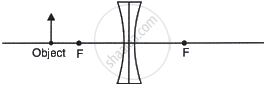
- Calculate the distance of the image from the lens by using the lens formula.
- Copy the figure below and draw rays to show how an image is formed by the lens.
- The diverging lens in part (a) is replaced by a converging lens also of focal length 100 mm. The object remains in the same position and an image is formed by the converging lens. Compare two properties of this image with those of the image formed by the diverging lens in part (a).
What do you understand by the focus and focal length of a spherical mirror? Show them on the separate diagrams for each of a concave mirror and a convex mirror.
Which are the two convenient rays that are chosen to construct the image by a spherical mirror for a given object? Explain with the help of suitable ray diagrams.
State the kind of mirror used
(a) by a dentist, and
(b) as a street light reflector.
Define the following terms in the context of spherical mirrors :
(i) Pole
(ii) Centre of curvature
(iii) Radius of curvature
(iv) Principal axis
A concave mirror forms a real image of an object placed in front of it at a distance 30 cm, of size three times the size of object. Find
- the focal length of mirror
- position of image.
Choose the correct alternative and rewrite the following:
Mirror used by a dental surgeon is ..........................
Numerical problem.
The radius of curvature of a spherical mirror is 25 cm. Find its focal length.
