Advertisements
Advertisements
प्रश्न
A concave mirror always forms a real image.
विकल्प
True
False
Advertisements
उत्तर
This statement is False.
Explanation:
A concave mirror can form both real and virtual images. The nature of the image depends on the distance of the object from the mirror.
APPEARS IN
संबंधित प्रश्न
Match the items given in Column I with one or more items of Column II.
| Column I | Column II | ||
| (a) | A plane mirror | (i) | Used as a magnifying glass. |
| (b) | A convex mirror | (ii) | Can form image of objects spread over a large area. |
| (c) | A convex lens | (iii) | Used by dentists to see enlarged image of teeth. |
| (d) | A concave mirror | (iv) | The image is always inverted and magnified. |
| (e) | A concave lens | (v) | The image is erect and of the same size as the object. |
| (vi) | The image is erect and smaller in size than the object. |
Mention the types of mirrors used as (i) rear view mirrors, (ii) shaving mirrors. List two reasons to justify your answers in each case.
State the number of images of an object placed between two mirrors, formed in each case when mirrors are inclined to each other at (a) 90°, and (b) 60°.
How is the focal length of a spherical mirror related to its radius of curvature?
Complete the following diagrams shown in the below figure by drawing the reflected ray for each incident ray.
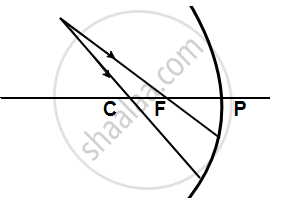
The distance from the pole to the focus is called ______.
Assertion: Incident ray is directed towards the centre of curvature of spherical mirror. After reflection it retraces its path.
Reason: Angle of incidence (i) = Angle of reflection (r) = 0°
Explain why a ray of light passing through the center of curvature of a concave mirror, gets reflected along with the same pattern.
