Advertisements
Advertisements
प्रश्न
An object 10 cm high is placed at a distance of 20 cm in front of a spherical mirror of focal length 25 cm. By scale drawing find the nature, position, and magnification of the image in the following case:
Concave mirror
Advertisements
उत्तर
Focal length =25 cm.
Object distance = 20 cm.
Height o f object = 10 cm.
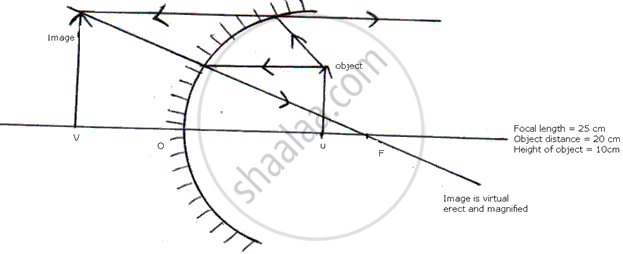
Image is virtual, erect, and magnified.
APPEARS IN
संबंधित प्रश्न
Define the following term in the context of spherical mirrors:- Principal focus
A concave mirror always forms a real image.
What is a virtual image?
- A small object is placed 150 mm away from a diverging lens of focal length 100 mm.
- Copy the figure below and draw rays to show how an image is formed by the lens.
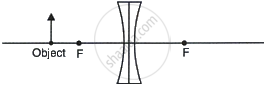
- Calculate the distance of the image from the lens by using the lens formula.
- Copy the figure below and draw rays to show how an image is formed by the lens.
- The diverging lens in part (a) is replaced by a converging lens also of focal length 100 mm. The object remains in the same position and an image is formed by the converging lens. Compare two properties of this image with those of the image formed by the diverging lens in part (a).
What is a spherical mirror?
Define the terms pole, principal axis and centre of curvature with reference to a spherical mirror.
An object is placed at 4 cm distance in front of a concave mirror of radius of curvature 24 cm. Find the position of image. Is the image magnified?
The radius of curvature of a spherical mirror is 18 cm. What is the focal length of this mirror?
The minimum length of the mirror required to see the full image of the person is half ‘ of his height.
