Advertisements
Advertisements
Question
A lens forms a real image 3 cm high of an object 1 cm high. If the separation of object and image is 15 cm, find the focal length of the lens.
Advertisements
Solution
Given,
Height of image (h') = - 3 cm (negative because image is real)
Height of object = 1 cm
Let us first define the sign convention:
Since the object distance is always negative, let it be -u.
Since the focal length is positive for a convex lens, let it be +f .
Magnification =`h/h=v/u`
`v/u=-3`
(i) Since object distance (u) is always negative, and the ratio `v/u` here is negative, v must be positive, i.e., it is on the right side of the lens.
Now, we have object distance + image distance = 15
`v+(-u)=15 (using sign convention)`
`-3u-u=15`
`-4u=15`
`u=(-15)/4`
Applying the lens formula:
`1/f=1/v-1/u`
`1/f=1/(-3u)-1/u`
`1/f=(-4)/(3u)`
`f=(3u)/-4=(3xx-15/4)/4=45/16=2.81`cm
Hence, the focal length of the lens is +2.81 cm.
APPEARS IN
RELATED QUESTIONS
A 4 cm tall object is placed on the principal axis of a convex lens. The distance of the object from the optical centre of the lens is 12 cm and its sharp image is formed at a distance of 24 cm from it on a screen on the other side of the lens. If the object is now moved a little away from the lens, in which way (towards the lens or away from the lens) will he have to move the screen to get a sharp image of the object on it again? How will the magnification of the image be affected?
Explain the following term related to spherical lenses:- optical centre
Define the following term in the context of spherical mirrors:- Pole
Give one use each of a concave and a convex mirror.
A ray of light is incident on a plane mirror at an angle of 30°. What is the angle of reflection
A ray of light is incident normally on a plane mirror. What will be the:
- angle of incidence?
- angle of reflection?
Define (a) centre of curvature (b) radius of curvature (c) pole (d) principal axis, and (e) aperture, of a spherical mirror with the help of a labelled diagram
Write the mirror formula. Give the meaning of each symbol which occurs in it.
Name the spherical mirror which can produce a virtual and diminished image of an object.
State the types of mirrors used for (i) headlights and (ii) rear view mirror, in cars and motorcycles. Give to justify your answer in each case.
Discuss the position and nature of image formed by a convex mirror when an object is moved from infinity towards the pole of mirror.
Answer the following question.
Write the modification in the curvature of the eye lens which enables us to see the nearby objects clearly?
What is the relationship between the focal length and radius of curvature?
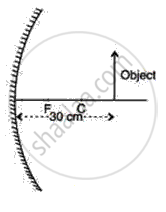
An object is placed in front of a concave mirror as shown in the following figure. By scale drawing, find the nature of the image. Given f = 10 cm, v = 30 cm.
In torches, search lights and headlights of vehicles the bulb is placed ______.
In the figure shown, the image of a real object is formed at the point I. AB is the principal axis of the mirror. The mirror must be: