Advertisements
Advertisements
प्रश्न
A lens forms a real image 3 cm high of an object 1 cm high. If the separation of object and image is 15 cm, find the focal length of the lens.
Advertisements
उत्तर
Given,
Height of image (h') = - 3 cm (negative because image is real)
Height of object = 1 cm
Let us first define the sign convention:
Since the object distance is always negative, let it be -u.
Since the focal length is positive for a convex lens, let it be +f .
Magnification =`h/h=v/u`
`v/u=-3`
(i) Since object distance (u) is always negative, and the ratio `v/u` here is negative, v must be positive, i.e., it is on the right side of the lens.
Now, we have object distance + image distance = 15
`v+(-u)=15 (using sign convention)`
`-3u-u=15`
`-4u=15`
`u=(-15)/4`
Applying the lens formula:
`1/f=1/v-1/u`
`1/f=1/(-3u)-1/u`
`1/f=(-4)/(3u)`
`f=(3u)/-4=(3xx-15/4)/4=45/16=2.81`cm
Hence, the focal length of the lens is +2.81 cm.
APPEARS IN
संबंधित प्रश्न
Explain the following term related to spherical lenses:- principal axis
What is the relation between the focal length and radius of curvature of a spherical mirror (concave mirror or convex mirror)?
When a spherical mirror is held towards the sun and its sharp image is formed on a piece of a carbon paper for some time, a hole is burnt in the carbon paper.
What is the advantage of using a carbon paper rather than a white paper?
Draw separate diagram for the formation of virtual image of an object by a concave mirror.
State the number of images of an object placed between two mirrors, formed in each case when mirrors are inclined to each other at (a) 90°, and (b) 60°.
What is a spherical mirror?
Draw suitable diagrams to illustrate the action of (i) concave mirror and (ii) convex mirror on a beam of light incident parallel to the principal axis.
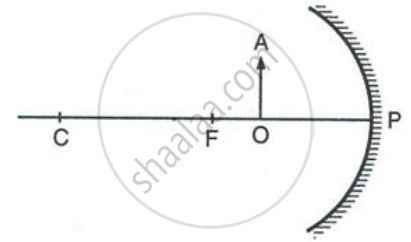
Figure shows a concave mirror with its pole at P, focus F and centre of curvature C. Draw ray diagram to show the formation of image of an object OA.
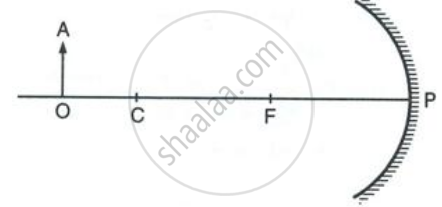
Figure shows a concave mirror with its pole at P, focus F and centre of curvature C. Draw ray diagram to show the formation of image of an object OA.
Define the following term:
convex mirror
Define the term Aperture.
Define the term Pole.
Draw a ray diagram to show that a convex mirror has a wider field of view.
The following Figure shows a concave mirror MM' on which a ray of light incident from a point P gets reflected to meet the principle axis at O.
(a) Find, by construction, the position of the centre of curvature of the concave mirror.
(b) Write down the value for the radius of curvature of the mirror.
(c) Calculate the focal length of the mirror.
(d ) Which relation is used in deducing the focal length from the radius of curvature?
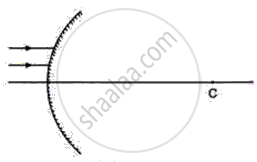
The diagram below shows the parallel rays incident on a convex mirror. C is the centre of the curvature of the mirror. By drawing the paths of the reflected rays, label the focus F and hence find the focal length of the mirror.
Size of image of an object by a mirror having a focal length of 20 cm is observed to be reduced to 1/3rd of its size. At what distance the object has been placed from the mirror? What is the nature of the image and the mirror?
The minimum length of the mirror required to see the full image of the person is half ‘ of his height.
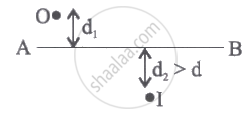
In the figure shown, the image of a real object is formed at the point I. AB is the principal axis of the mirror. The mirror must be: