Advertisements
Advertisements
Question
- A small object is placed 150 mm away from a diverging lens of focal length 100 mm.
- Copy the figure below and draw rays to show how an image is formed by the lens.
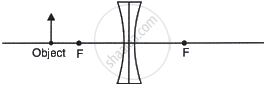
- Calculate the distance of the image from the lens by using the lens formula.
- Copy the figure below and draw rays to show how an image is formed by the lens.
- The diverging lens in part (a) is replaced by a converging lens also of focal length 100 mm. The object remains in the same position and an image is formed by the converging lens. Compare two properties of this image with those of the image formed by the diverging lens in part (a).
Advertisements
Solution
a. i. The image formed by the lens is virtual, erect and diminished in size.
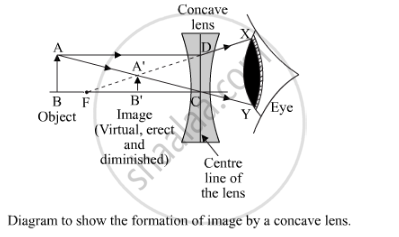
ii. Object distance (u) = −150 mm = −15 cm (sign convention)
Focal length (f) = −100 mm = −10 cm (sign convention)
Image distance (v) = ?
By using the lens formula:
`1/v - 1/u = 1/f`
`1/v - 1/-15 = 1/-10`
`1/v + 1/15 = -1/10`
`1/v = 1/10-1/15`
`1/v = (-3-2)/30`
`1/v = (-5)/30`
v = −6 cm
b.
| Property | Image by diverging lens (Part a) | Image by converging lens (Part b) |
| Nature of image | Virtual and Erect (formed on the same side as the object) | Real and Inverted (formed on the opposite side of the lens) |
| Size/Magnification | Diminished (magnification is 0.4, making the image smaller) | Magnified / Enlarged (magnification is −2, making the image twice the size) |
APPEARS IN
RELATED QUESTIONS
What is a virtual image?
Name the two types of spherical mirrors. What type of mirror is represented by the:
- back side of a shining steel spoon?
- front side of a shining steel spoon?
State whether the image in part (a) is real or virtual?
Write two more characteristics of the image.
State two uses of a concave mirror.
At what distance from a concave mirror of focal length 25 cm should an object be placed so that the size of image is equal to the size of the object.
An object 5 cm high forms a virtual image of 1.25 cm high, when placed in front of a convex mirror at a distance of 24 cm. Calculate:
- the position of the image
- the focal length of the convex mirror.
Select the correct option:
A concave mirror is made by cutting a portion of a hollow glass sphere of radius 30 cm. The focal length of the concave mirror is:
Define the following term in relation to concave mirror.
Principal focus
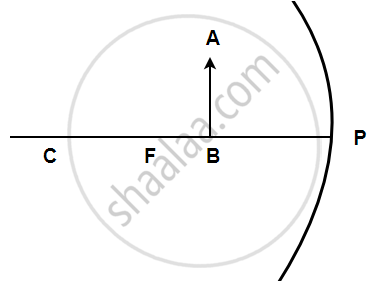
In the following figure shows a concave mirror with its pole (P), focus (F) and centre of curvature (C). Draw a ray diagram to show the formation of the image of an object AB by the concave mirror.
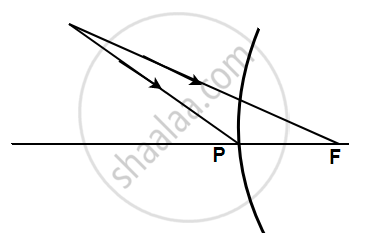
Complete the following diagrams shown in the following figures by drawing the reflected rays.
The spherical mirror with a reflecting surface curved inward is called
The distance from the pole to the focus is called ______.
What is the focal length (f) of a mirror?
In the figure shown, the image of a real object is formed at the point I. AB is the principal axis of the mirror. The mirror must be: