Advertisements
Advertisements
Question
Which are the two convenient rays that are chosen to construct the image by a spherical mirror for a given object? Explain with the help of suitable ray diagrams.
Advertisements
Solution
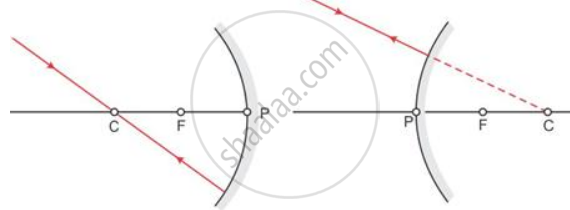
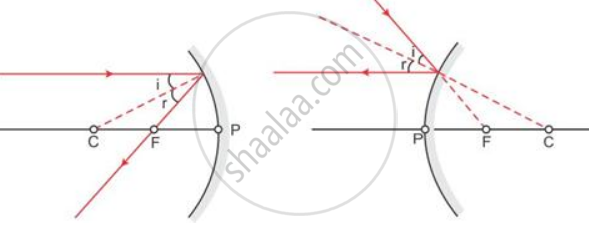
Two convenient rays that are chosen to construct the image by a spherical mirror for a given object :
- A ray passing through the centre of curvature: A ray of light passing through the centre of curvature of a concave mirror or a ray directed in the direction of the centre of curvature of a convex mirror is reflected back along the same path after reflection.
- A ray parallel to the principal axis: A ray of light parallel the principal axis, after reflection pass through the principal focus in case of a concave mirror or appears to diverge from it in case of a convex mirror.
APPEARS IN
RELATED QUESTIONS
Complete the following sentence:
All the distances are measured from the .......... of a spherical mirror.
Explain the following term:
Incident ray
Draw diagram/diagrams to show them.
Define the terms pole, principal axis and centre of curvature with reference to a spherical mirror.
Define the terms focus and focal length of a concave mirror. Draw diagram to illustrate your answer.
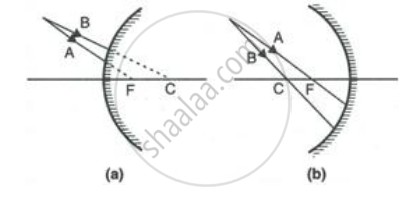
Complete the following diagrams shown in Fig. by drawing the reflected ray for each of the incident ray A and B.
Define the term Principle focus.
An object is placed at a distance of 0.25 m
in front of a plane mirror. The distance between the object and image will be ______.
What is “aperture”?
