Advertisements
Advertisements
प्रश्न
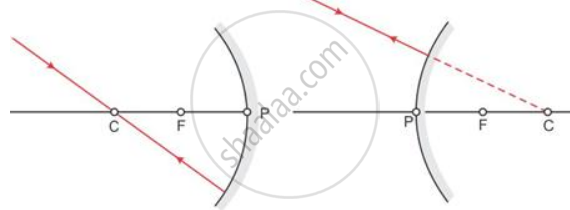
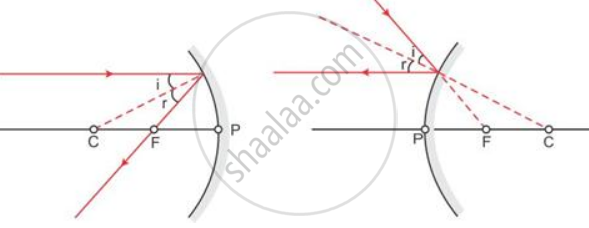
Which are the two convenient rays that are chosen to construct the image by a spherical mirror for a given object? Explain with the help of suitable ray diagrams.
Advertisements
उत्तर
Two convenient rays that are chosen to construct the image by a spherical mirror for a given object :
- A ray passing through the centre of curvature: A ray of light passing through the centre of curvature of a concave mirror or a ray directed in the direction of the centre of curvature of a convex mirror is reflected back along the same path after reflection.
- A ray parallel to the principal axis: A ray of light parallel the principal axis, after reflection pass through the principal focus in case of a concave mirror or appears to diverge from it in case of a convex mirror.
APPEARS IN
संबंधित प्रश्न
Explain the following term related to spherical lenses:- centres of curvature
What type of image is formed:
- in a plane mirror?
- on a cinema screen?
What kind of mirror is required for obtaining a virtual image of the same size as the object?
A diverging lens is used in ______.
How will you distinguish between a plane mirror, a concave mirror and a convex mirror, without touching them?
The focal length of a concave mirror is 10 cm. Find its radius of curvature.
A point light source is kept in front of a convex mirror at a distance of 40 cm. The focal length of the mirror is 40 cm. Find the position of image.
An object 10 cm high is placed at a distance of 20 cm in front of a spherical mirror of focal length 25 cm. By scale drawing find the nature, position, and magnification of the image in the following case:
Convex mirror
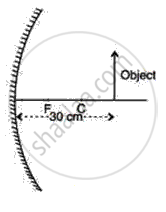
An object is placed in front of a concave mirror as shown in the following figure. By scale drawing, find the nature of the image. Given f = 10 cm, v = 30 cm.
Visit a nearby hospital. You can also visit the clinic of an ENT specialist, or a dentist. Request the doctor to show you the mirrors used for examining ear, nose, throat and teeth. Can you recognise the kind of mirror used in these instruments?
