Advertisements
Online Mock Tests
Chapters
![Lakhmir Singh solutions for फिज़िक्स [इंग्रजी] इयत्ता १० आईसीएसई chapter 6 - Spectrum - Shaalaa.com](/images/physics-english-class-10-icse_6:bfbcc704031b4fd398b72f80ee978e3f.jpg "Lakhmir Singh solutions for फिज़िक्स [इंग्रजी] इयत्ता १० आईसीएसई chapter 6 - Spectrum")
Advertisements
Solutions for Chapter 6: Spectrum
Below listed, you can find solutions for Chapter 6 of CISCE Lakhmir Singh for फिज़िक्स [इंग्रजी] इयत्ता १० आईसीएसई.
Lakhmir Singh solutions for फिज़िक्स [इंग्रजी] इयत्ता १० आईसीएसई 6 Spectrum Intex Question [Pages 140 - 149]
THINK AND ANSWER
Can you see a spectrum ofcolours when light passes through a flat pane of glass or a hollow prism?
TEST YOUR UNDERSTANDING - 1
Explain the dependence of the deviation of light produced by a glass prism on the wavelength or colour of light.
What is a dispersion of light?
What do you understand by the term spectrum?
Explain the cause of dispersion of white light through a prism.
What did Newton demonstrate by his experiments with the prism?
What colours make up white light?
Fill in the following blanks with suitable words.
The colour of white light deviated through the largest angle by a prism is ______.
The colour of light which undergoes the least bending on passing through the glass prism is ______.
The dispersion of white light occurs at the ______ surface of the glass prism.
Draw a diagram to show how white light can be dispersed into a spectrum by using a glass prism. Mark the various colours of the spectrum.
Which are the extreme colours in a pure spectrum?
Calculate the frequency of red light of wavelength 7000 Å. The speed of light is 3 × 10⁸ m/s.
THINK AND ANSWER
Give reason for the following:
The photographic dark rooms are provided with infrared lamps.
THINK AND ANSWER
Why do welders wear mask while welding?
TEST YOUR UNDERSTANDING - 2
Define invisible spectrum.
Classify the radiations in the electromagnetic spectrum in order of increasing wavelength.
State two properties of ultraviolet radiation which differ from visible light.
Explain infrared radiation.
State the properties of infrared radiation.
State the uses of infrared radiation.
Explain ultraviolet radiation.
State the properties of ultraviolet radiation.
State the uses of ultraviolet radiation.
State the properties that are common to all electromagnetic radiations.
Name the radiation that is used in the detection of the purity of gemstones. State its source.
Name the electromagnetic radiation that is used in the study of crystals. Give another important use of these rays.
Why is the infrared radiation preferred over visible light for photography in the fog?
How can the presence of infrared radiations be detected?
THINK AND ANSWER
Although violet light has a shorter wavelength compared to blue light, the sky appears blue and not violet. Why is it so?
TEST YOUR UNDERSTANDING - 3
What is scattering of light?
State one effect produced by the scattering of light by the atmosphere.
What colour does the sky appear to an astronaut?
Why does sun appear red at sunrise and sunset?
What happens when a beam of sunlight enters a dusty room through a window? Explain your answer.
Why are the ‘danger signal’ lights red in colour?
Why does the sky appear blue on a clear day?
Out of blue light and red light, which one is scattered more easily?
State the relation between the intensity of scattering of light and the wavelength of light.
Lakhmir Singh solutions for फिज़िक्स [इंग्रजी] इयत्ता १० आईसीएसई 6 Spectrum EXERCISE [Pages 151 - 154]
Objective Questions
True or False.
The velocity of light increases on increasing the wavelength of light.
True or False.
Gamma rays have the frequency higher than that of the violet light.
True or False.
The different colours of the white light travel with the same velocity.
True or False.
Rock salt prism is used to obtain an infrared spectrum.
True or False.
Red light exhibits the maximum scattering.
Fill in the Blanks
A spectrum of ultraviolet light can be obtained using a ______ prism.
A thermopile can detect ______ radiations.
Silver chloride solution can detect the presence of ______ radiations.
The region beyond the red end of the visible spectrum is known as ______ region.
All electromagnetic radiations travel with a speed of ______ m/s.
Multiple Choice Questions
The coloured light having the maximum speed in glass prism is ______.
blue
green
violet
yellow
Which of the following is the most energetic electromagnetic radiation?
Ultraviolet rays
Gamma rays
X-rays
Microwaves
When red light is refracted by a glass prism such that the angle of deviation is minimum, the angle of emergence is ______ the angle of incidence.
greater than
less than
equal to
none of these
The splitting up of white light into seven colours on passing through a glass prism is called ______.
refraction
deflection
dispersion
scattering
reflection
Sunset is red because at that time the light coming from the sun has to travel:
lesser thickness of earth's atmosphere
greater thickness of earth's atmosphere
varying thickness of earth's atmosphere
along the horizon
If λb, λg and λy are the wavelengths of blue, green and yellow light, which of the following is correct?
λy > λg > λb
λy > λb > λg
λg > λb > λy
λb > λy > λg
In sunlight, which of the following is scattered the maximum by air molecules present in the Earth’s atmosphere?
Green colour
Red colour
Blue colour
Yellow colour
The Sun appears red during sunrise and sunset because ______.
blue colour is least scattered
red colour is least scattered
blue colour is most scattered
red colour is most scattered
The wavelength range of white light is ______.
4000 nm to 8000 nm
40 nm to 80 nm
400 nm to 800 nm
4 nm to 8 nm
10 to 400 nm
Which ofthe following has the maximum penetrating power?
Gamma rays
Beta rays
X-rays
Alpha rays
Match the items of Column I with that of Column II and choose the appropriate code.
| Column I | Column II |
| A. Crystallography | (i) Ultraviolet rays |
| B. Detection of purity of gemstones | (ii) Gamma rays |
| C. Television remote control | (iii) X-rays |
| D. Treatment of cancer | (iv) Infrared rays |
A - (iii), B - (ii), C - (iv), D - (i)
A - (iv), B - (i), C - (iii), D - (ii)
A - (iii), B - (i), C - (iv), D - (ii)
A - (iv), B - (ii), C - (i), D - (iii)
Descriptive Questions Short Answer Questions
Describe how you could demonstrate that white light is composed of a number of colours.
Explain pure spectrum.
Explain impure spectrum.
State the names of radiations in the electromagnetic spectrum along with their wavelength ranges.
Give the range of wavelength of the electromagnetic waves visible to us.
How can the presence of ultraviolet radiation be detected?
Which colour of light travels fastest in any medium except air?
An electromagnetic radiation is used for photography in fog. [2]
(i) Identify the radiation.
(ii) Why is this radiation mentioned by you, ideal for this purpose ?
Why do ultraviolet bulbs have an outer envelope made of quartz instead of glass?
Explain the source of microwaves.
Give two uses of Microwaves.
Explain the source of X-rays.
State one use of X-rays.
Why does the sun appear red at sunset?
Why does the sky appear dark (or black) to an astronaut instead of blue?
What causes scattering of light?
Why is infrared radiation also known as heat radiation? Mention its source.
How is dispersion of light different from scattering?
White light is polychromatic in nature. Explain.
What will be the colour of the sky on a planet that does not have atmosphere? Why?
An electromagnetic wave has a wavelength of 70 Å. Name the wave and state its source and uses.
Draw a ray diagram to show the refraction of a monochromatic ray through a prism when it suffers minimum deviation.
Name the radiations that are used for photography at night.
Name the radiations used for the detection of fracture in bones.
Name the radiations whose wavelength range is from 100 Å to 4000 Å (or 10 nm to 400 nm).
Light of different colours is deviated through different angles by a prism. Explain the reason.
Long Answer Questions
Explain why, when the sun is overhead at noon, it appears white, but when the same sun is near the horizon at sunset, it appears red.
Which ray exists beyond the red end of the visible spectrum in an electromagnetic spectrum? State its properties, uses and detection method (one each).
Define spectrum. Explain its formation with the help of a neat, labelled diagram.
Explain giving reason why the sky appears blue to an observer from the surface of the earth? What will the colour of the sky be for an astronaut staying in the international space station orbiting the earth? Justify your answer giving reason.
The diagram below shows the path taken by a narrow beam of yellow monochromatic light passing through an equiangular glass prism. If the yellow light is replaced by a narrow beam of white light incident at the same angle, draw another diagram to show the passage of white light through the prism and label it to show the effect of prism on the white light.

(i) The diagram shows a ray of light incident on an equilateral glass prism placed in minimum deviation position.
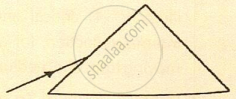
Copy the diagram and complete it to show the path of the refracted ray and the emergent ray.
(ii) How are angle of incidence and angle of emergence related to each other in this position of the prism?
How will you investigate the existence of the radiation beyond the red and violet extremes of the spectrum?
A ray of white light is passed through a glass prism and a spectrum is obtained on a screen.
- Name the seven colours of the spectrum in order.
- Do the colours have the same width in the spectrum?
- Which of the colour of the spectrum of white light deviates (i) the most, (ii) the least?
Numerical Problems
A plane electromagnetic wave travels in the vacuum along the z-direction. What can you say about the directions of its electric and magnetic field vectors? If the frequency of the wave is 30 MHz, what is its wavelength?
Calculate the wavelength of an electromagnetic wave of frequency 1012 Hz. Consider the speed of the wave as 3 × 10⁸ m/s.
The wavelength of X-rays is 0.01 Å. Calculate its frequency. State the assumption made, if any.
Calculate the frequency of yellow light of wavelength 550 nm. The speed of light is 3 × 10⁸ m/s-1.
DO IT RIGHT
| Sona was standing outside her house in the afternoon enjoying the light drizzle after the heavy rain. Suddenly she saw a rainbow in the sky. Sona called out her father and asked him what a rainbow is and how it is formed. Sona’s father told her that rainbow is an arch of seven colours visible in the sky which is produced by the splitting of white sunlight by tiny raindrops in the atmosphere. He also told Sona that a similar phenomenon can also be observed in a science laboratory by passing white light through a transparent object. |
- What is the name of the phenomenon which produces a rainbow?
- Name the seven colours of the rainbow. Which of them deviates the most?
- When the rainbow is formed, state whether the sun is shining in the sky or not.
- Name the transparent object which can be used to observe the phenomenon similar to a rainbow in the science laboratory.
- What values are displayed by Sona’s father?
Create a poster of the electromagnetic spectrum. Identify the different waves and draw illustrations or paste pictures showing their wavelength. Include images of uses of each wave in the spectrum. Find out and write interesting features of each wave in the poster.
Solutions for 6: Spectrum
Lakhmir Singh solutions for फिज़िक्स [इंग्रजी] इयत्ता १० आईसीएसई chapter 6 - Spectrum
Shaalaa.com has the CISCE Mathematics फिज़िक्स [इंग्रजी] इयत्ता १० आईसीएसई CISCE solutions in a manner that help students grasp basic concepts better and faster. The detailed, step-by-step solutions will help you understand the concepts better and clarify any confusion. Lakhmir Singh solutions for Mathematics फिज़िक्स [इंग्रजी] इयत्ता १० आईसीएसई CISCE 6 (Spectrum) include all questions with answers and detailed explanations. This will clear students' doubts about questions and improve their application skills while preparing for board exams.
Further, we at Shaalaa.com provide such solutions so students can prepare for written exams. Lakhmir Singh textbook solutions can be a core help for self-study and provide excellent self-help guidance for students.
Concepts covered in फिज़िक्स [इंग्रजी] इयत्ता १० आईसीएसई chapter 6 Spectrum are .
Using Lakhmir Singh फिज़िक्स [इंग्रजी] इयत्ता १० आईसीएसई solutions Spectrum exercise by students is an easy way to prepare for the exams, as they involve solutions arranged chapter-wise and also page-wise. The questions involved in Lakhmir Singh Solutions are essential questions that can be asked in the final exam. Maximum CISCE फिज़िक्स [इंग्रजी] इयत्ता १० आईसीएसई students prefer Lakhmir Singh Textbook Solutions to score more in exams.
Get the free view of Chapter 6, Spectrum फिज़िक्स [इंग्रजी] इयत्ता १० आईसीएसई additional questions for Mathematics फिज़िक्स [इंग्रजी] इयत्ता १० आईसीएसई CISCE, and you can use Shaalaa.com to keep it handy for your exam preparation.
