Advertisements
Online Mock Tests
Chapters
![Lakhmir Singh solutions for फिज़िक्स [इंग्रजी] इयत्ता १० आईसीएसई chapter 3 - Machines - Shaalaa.com](/images/physics-english-class-10-icse_6:bfbcc704031b4fd398b72f80ee978e3f.jpg "Lakhmir Singh solutions for फिज़िक्स [इंग्रजी] इयत्ता १० आईसीएसई chapter 3 - Machines")
Advertisements
Solutions for Chapter 3: Machines
Below listed, you can find solutions for Chapter 3 of CISCE Lakhmir Singh for फिज़िक्स [इंग्रजी] इयत्ता १० आईसीएसई.
Lakhmir Singh solutions for फिज़िक्स [इंग्रजी] इयत्ता १० आईसीएसई 3 Machines Intex Question [Pages 55 - 67]
TEST YOUR UNDERSTANDING - 1
How is mechanical advantage related to the velocity ratio for an ideal machine?
Give one example of a simple machine.
Write a relation for velocity ratio in terms of distance moved by the load and effort.
Name a simple machine used as a force multiplier.
Name a machine to obtain gain in speed?
State the unit of mechanical advantage.
State the unit of velocity ratio.
Write the relation of efficiency of an actual machine.
THINK AND ANSWER
Which class of levers does the following belong to?
Wheel barrow, pliers, scissors and nut cracker
TEST YOUR UNDERSTANDING - 2
What is a lever?
Answer the following.
State the principle of levers.
Which type of levers have mechanical advantage always more than 1? Give reasons.
To use a machine as a force multiplier, what class of lever should be preferred?
Write down a relation expressing the mechanical advantage of a lever.
Give an example of each class of lever in a human body.
Explain why the mechanical advantage of a class II of lever is always more than 1.
Calculate the ideal mechanical advantage of a lever where the effort arm is 75 cm and the load arm is 15 cm.
TEST YOUR UNDERSTANDING - 3
Which type of pulley is used for changing the direction of efforts?
For a force multiplier, which type of pulley is used?
Write the relation between mechanical advantage, velocity ratio and efficiency for an ideal single fixed pulley.
Write the expression for the mechanical advantage of n movable pulleys with one fixed pulley.
Write the expression for the velocity ratio of n movable pulley with one fixed pulley.
Is the pulley system also an energy multiplier?
A pulley system has three pulleys. A load of 60 N is overcome by applying an effort of 12 N. Calculate its mechanical advantage.
Lakhmir Singh solutions for फिज़िक्स [इंग्रजी] इयत्ता १० आईसीएसई 3 Machines EXERCISE [Pages 68 - 73]
Objective Questions
The velocity ratio of a single movable pulley is always 2.
True
False
The velocity ratio of a single fixed pulley is always more than 1.
True
False
True or False.
A scissor is a speed multiplier.
True or False.
The mechanical advantage of a machine can be less than one.
True or False.
For Class II lever, MA < 1.
Fill in the Blanks
In class II lever, effort arm is ______ than the load arm.
Mechanical advantage = ______ × velocity ratio.
For n movable pulleys with one fixed pulley, the mechanical advantage is ______.
In Class I lever, ______ is in between the load and effort.
A sugar tong is an example of ______ lever.
Multiple Choice Questions
The mechanical advantage of an ideal single movable pulley is ______.
1
2
less than 2
less than 1
Which of the statement is not true for a machine?
It can multiply force.
It can increase speed.
It can change the direction of applied force.
Output is more than the input.
The correct relationship between the effort (E), load (L) and MA is:
MA = L × E
MA × E = L
MA × L = E
None of these
A fire tongs is a lever of ______.
Third order
Second order
First order
Zero order
A single fixed pulley is used because ______.
its efficiency is 100%.
it multiplies effort.
it multiplies speed.
it changes the direction of applied effort.
A pulley system has 7 pulleys in all. Its velocity ratio is ______.
less than 7
more than 7
equal to 7
none of these
Class II levers are designed to have ______.
M.A. = V.R.
M.A. > V.R.
M.A. > 1
M.A. < 1
An actual pulley system always has mechanical advantage less than velocity ratio because:
A part of effort is wasted in overcoming friction.
A part of effort is wasted in overcoming the load of the movable block.
A part of the effort is wasted in overcoming friction, and another part of the effort is wasted in overcoming the load of the movable block.
None of these
If a machine is used as a force multiplier, then ______.
Effort > Load
Effort < Load
Effort = Load
None of these
Mechanical advantage of a machine is given by ______.
Effort/load
Load/effort
Effort × load
Effort + load
Match the items of Column I with that of Column II and choose the appropriate code.
| Column I | Column II |
| A. Scissors | (i) Class II lever |
| B. Fire tong | (ii) Class I lever |
| C. Nut cracker | (iii) Class III lever |
A - (ii), B - (iii), C - (i)
A - (i), B - (ii), C - (iii)
A - (iii), B - (ii), C - (i)
A - (ii), B - (i), C - (iii)
Descriptive Questions Short Answer Questions
Name the type of single pulley that has a mechanical advantage greater than one.
What is an ideal machine?
Why should the lower block of a block and tackle pulley system have negligible weight?
To use a machine as a force multiplier, what class of lever should be preferred?
Which class of lever found in the human body is being used by a boy when he raises the weight of his body on his toes?
State the unit of mechanical advantage.
What is the ratio between the mechanical advantage and velocity ratio of a practical machine?
Can a simple machine act as a force multiplier and a speed multiplier at the same time?
What is the velocity ratio of a single fixed pulley?
What is the velocity ratio of a single movable pulley?
Name a machine which is used to multiply speed.
What is a single movable pulley?
How is a movable pulley different from a fixed pulley?
What is the use of a single fixed pulley, although its mechanical advantage is 1 or less than 1?
Define mechanical advantage (M.A.) of the machine.
Define Velocity Ratio
Define the term efficiency of a machine.
How are mechanical advantage, velocity ratio and efficiency related?
How do you distinguish between a lever of the first order from a second and third order lever?
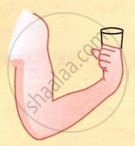
The figure shows a human hand. Mark the positions of load, effort and fulcrum in the diagram. Which type of lever is the hand?
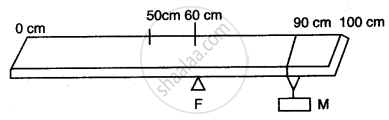
A uniform metre scale is kept in equilibrium when supported at the 60 cm mark and a mass M is suspended from the 90 cm mark as shown in the figure. State with reasons, whether the weight of the scale is greater than, less than or equal to the weight of mass M.
When we want to use a machine as a force multiplier, which class of lever should we preferably use? Give a simple diagram of such a lever.
Explain why scissors for cutting cloth may have blades longer than the handles, but shears for cutting metals have short blades and long handles.
The following are an example of levers. State the class of lever to which each one belongs giving the relative positions of Load (L), Effort (E), Fulcrum (F):
(i) Scissors (ii) Sugar tongs (iii) Nutcracker (iv) Pliers.
Draw a diagram to show how a single pulley can be used so as to have its ideal MA = 2. Derive an expression between MA, VR and efficiency of a machine.
A block and tackle system of pulleys has a velocity ratio of 4.
- Draw a labelled diagram.
- What is the value of MA for an ideal pulley system?
- What will be its velocity ratio if the weight of the movable blocks is doubled?
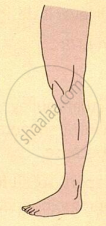
The figure shows a human foot. Mark the positions of load, effort and fulcrum in the foot. Name the type of lever.
Long Answer Questions
Show a neat diagram to explain the working of a single fixed pulley. Calculate the mechanical advantage and velocity ratio for this pulley.
The figure given shows a block and tackle system of four pulleys. Draw a string around the pulleys. Also, show the position and the direction of effort to be applied on this string. What is the mechanical advantage and velocity ratio of this system?
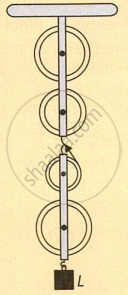
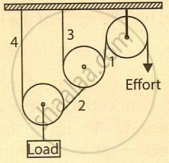
The given figure shows an arrangement of moving and fixed pulleys. Copy the diagram and show the direction and magnitude of forces exerted by the four strings marked 1 to 4. What is the load that can be lifted by the effort E? Calculate the mechanical advantage of this system.
Draw two different sets of block and tackle systems to obtain a mechanical advantage of 4.
Differentiate between a single fixed pulley and a single movable pulley.
Draw a labelled diagram of an arrangement of two pulleys, one fixed and other movable. In the diagram, mark the directions of all forces acting on it. What is the ideal mechanical advantage of the system? How can it be achieved?
State the principle of an ideal machine.
Derive the relationship between mechanical advantage, velocity ratio and efficiency of a machine.
What is a lever?
Name the three classes of levers and state how are they distinguished. Give two examples of each class.
Numerical Problems
A pulley system has a velocity ratio of 4 and an efficiency of 90%. Calculate its mechanical advantage.
In a single movable pulley, if the effort moves by a distance of 10 cm upward, by what height is the load raised?
A pulley system has three pulleys. A load of 125 N is overcome by applying an effort of 50 N. Calculate the mechanical advantage of the system.
An inclined plane makes an angle of 20° with the horizontal. What is its mechanical advantage? If a man can put maximum effort of 40 kgf, what will be the minimum load that he can push on this plane? (sin 20° = 0.34)
How many movable pulleys are there in a system of 3 pulleys? What is the mechanical advantage and velocity ratio of this system? If the efficiency of the system is 100%, what effort is needed to lift a load of 350 kgf attached to it?
How many movable pulleys are there in a system of 4 pulleys? What is the mechanical advantage and velocity ratio of this system? If the efficiency of the system is 80%, what effort is required to lift a load of 40 kgf from this system?
The number of teeth in driving and the driven gears of a gear system are 20 and 250, respectively. What is the mechanical advantage of this system?
A machine uplifts a load of 100 N by 10 cm. In this process, it requires 80 N of effort with downward displacement of 15 cm. Calculate:
- mechanical advantage
- velocity ratio
- work input
- efficiency of the machine
The angle of elevation of an inclined plane is 30°.
- What is its mechanical advantage?
- How much effort is required to lift a load of 100 kgf on this plane?
- If the increase in the potential energy of the load is 5000 J, how much distance has it moved on the plane?
A man applies the effort of 150 N on one end of a fixed pulley to pull a bucket of water of mass 12 kg. What is the force of friction, mechanical advantage and efficiency of this pulley?
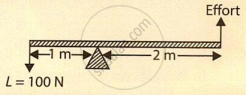
The given figure shows a simple lever.
- What class of lever this figure belongs to?
- What is the minimum effort to overcome the load of 100 N?
- What is the mechanical advantage of lever if efficiency of the lever is 100%?
- What is its velocity ratio?
A system of pulleys consists of three fixed and two movable pulleys.
- What is the mechanical advantage of this system?
- How much effort is required to pull 20 kgf through this system?
- If the efficiency of the system is 70%, what is its velocity ratio?
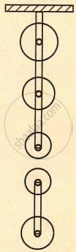
The given figure shows a system of five pulleys. The upper three pulleys are fixed and the lower two pulleys are movable. Draw a string around the pulleys. Mark the position of effort to be applied. What is the velocity ratio and mechanical advantage of this system?
An effort of 10 kgf is applied on a machine through a displacement of 105 cm when a load of 200 kgf moves through a distance of 5 cm. Calculate (i) mechanical advantage, (ii) velocity ratio and (iii) efficiency of the machine.
Draw a diagram of a combination of three movable pulleys and one fixed pulley to lift up a load. In the diagram, show the directions of load, effort and tension in each strand. Find:
- mechanical advantage,
- Velocity ratio and
- efficiency of the combination in ideal situation.
DO IT RIGHT
Look around your house and find out the household items that can be considered as simple machines. Categorise each item based on the three classes of levers. Try to find out effort, load and fulcrum in these items. Record your findings and discuss the results with your friends and teacher.
Solutions for 3: Machines
Lakhmir Singh solutions for फिज़िक्स [इंग्रजी] इयत्ता १० आईसीएसई chapter 3 - Machines
Shaalaa.com has the CISCE Mathematics फिज़िक्स [इंग्रजी] इयत्ता १० आईसीएसई CISCE solutions in a manner that help students grasp basic concepts better and faster. The detailed, step-by-step solutions will help you understand the concepts better and clarify any confusion. Lakhmir Singh solutions for Mathematics फिज़िक्स [इंग्रजी] इयत्ता १० आईसीएसई CISCE 3 (Machines) include all questions with answers and detailed explanations. This will clear students' doubts about questions and improve their application skills while preparing for board exams.
Further, we at Shaalaa.com provide such solutions so students can prepare for written exams. Lakhmir Singh textbook solutions can be a core help for self-study and provide excellent self-help guidance for students.
Concepts covered in फिज़िक्स [इंग्रजी] इयत्ता १० आईसीएसई chapter 3 Machines are .
Using Lakhmir Singh फिज़िक्स [इंग्रजी] इयत्ता १० आईसीएसई solutions Machines exercise by students is an easy way to prepare for the exams, as they involve solutions arranged chapter-wise and also page-wise. The questions involved in Lakhmir Singh Solutions are essential questions that can be asked in the final exam. Maximum CISCE फिज़िक्स [इंग्रजी] इयत्ता १० आईसीएसई students prefer Lakhmir Singh Textbook Solutions to score more in exams.
Get the free view of Chapter 3, Machines फिज़िक्स [इंग्रजी] इयत्ता १० आईसीएसई additional questions for Mathematics फिज़िक्स [इंग्रजी] इयत्ता १० आईसीएसई CISCE, and you can use Shaalaa.com to keep it handy for your exam preparation.
