Advertisements
Advertisements
प्रश्न
The following are an example of levers. State the class of lever to which each one belongs giving the relative positions of Load (L), Effort (E), Fulcrum (F):
(i) Scissors (ii) Sugar tongs (iii) Nutcracker (iv) Pliers.
Advertisements
उत्तर
| Name of Lever | Lever Class | Fulcrum | Position of Effort | Load | ||
| (i) | Scissors | First | At centre | One end | Other end | |
| (ii) | Sugar tongs | Third | One end | At centre | Other end | |
| (iii) | Nutcracker | Second | One end | Other end | At centre | |
| (iv) | Pliers | First | At centre | One end | Other end | |
APPEARS IN
संबंधित प्रश्न
Class II levers are designed to have ______.
Fig 3.17 below shows a lever in use.
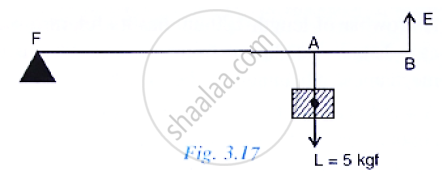
(a) To which class of lever does it belong?
(b) If FA = 80 cm, AB = 20 cm, find its mechanical advantage.
(c) Calculate the value of E.
Which class of lever found in the human body is being used by a boy when he holds a load on the palm of his hand.
Which class of lever found in the human body is being used by a boy when he raises the weight of his body on his toes?
The following belong to which class of lever?
The Physical balance
The following belong to which class of lever?
A fire tongs
The following belong to which class of lever?
Wheelbarrow
The following belong to which class of lever?
Knife
In the following diagram of a wheelbarrow, mark the fulcrum (F) and indicate the directions of load (L) and effort (E) with arrows.

What class of lever is it? Give one more example of the same class of lever.
The diagram shows the use of a lever.

- State the principle of moments as applied to the above lever.
- Which class of lever is this? Give an example of this class of lever.
- If FA = 100 cm, AB = 90 cm, calculate the minimum effort required to lift the load.
