Advertisements
Advertisements
प्रश्न
State the types (or kinds) of lever, and give two examples of each kind.
Advertisements
उत्तर
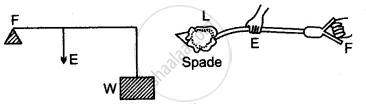
There are three kinds of the lever, depending upon the different positions of the load, fulcrum and the effort.
Type I: When fulcrum is in the middle.
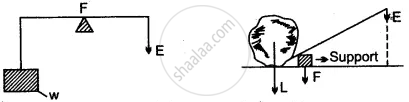
Type II: When the load is between the fulcrum and the effort.

Type III: When the effort lies between the fulcrum and load.
संबंधित प्रश्न
State the principle of a lever?
Draw a diagram of a lever which is always used as a force multiplier. How is the effort arm related to the load arm in such a lever?
Define lever.
A lever of length 9 cm has its load arm 5 cm long and the effort arm is 9 cm long.
- To which class does it belong?
- Draw a diagram of the lever showing the position of fulcrum F and directions of both the load L and effort E.
- What is the mechanical advantage and velocity ratio if the efficiency is 100%?
- What will be the mechanical advantage and velocity ratio if the efficiency becomes 50%?
The following belong to which class of lever?
The Physical balance
The following belong to which class of lever?
A claw-hammer
The following belong to which class of lever?
Rowing of a boat
The following belong to which class of lever?
Knife
The diagram below shows a lever in use.

(i) To which class of lever does it belong?
(ii) If FA = 40 cm, AB = 60 cm, then find the mechanical advantage of the lever.
A crowbar of length 100 cm is used to lift a load of 5 kgf. It has its fulcrum at a distance of 20 cm from the load. Calculate:
(i) the mechanical advantage of a crowbar and,
(ii) the effort applied at the other end.
