Advertisements
Advertisements
प्रश्न
What is a lever?
Advertisements
उत्तर
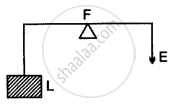
A lever is a special case of the application of the law of moments. It is a rigid bar, straight or bent, which is capable of rotation about a fixed point or a fixed-line, called the axis of rotation. This fixed point or the axis of rotation is called the fulcrum. An effort E is applied at point A of the lever to overcome resistance (or load) at another point B, as shown in the diagram.
संबंधित प्रश्न
Write down a relation expressing the mechanical advantage of a lever.
Draw a diagram of a lever which is always used as a force multiplier. How is the effort arm related to the load arm in such a lever?
The lever for which the mechanical advantage is less than 1 has :
Define lever.
Which type of levers have mechanical advantage always more than 1? Give reasons.
Give three examples for leavers of the third order.
The following belong to which class of lever?
A fire tongs
The following belong to which class of lever?
Nutcracker
The following are an example of levers. State the class of lever to which each one belongs giving the relative positions of Load (L), Effort (E), Fulcrum (F):
(i) Scissors (ii) Sugar tongs (iii) Nutcracker (iv) Pliers.
The diagram shows the use of a lever.

- State the principle of moments as applied to the above lever.
- Which class of lever is this? Give an example of this class of lever.
- If FA = 100 cm, AB = 90 cm, calculate the minimum effort required to lift the load.
