Advertisements
Advertisements
प्रश्न
A lever of length 9 cm has its load arm 5 cm long and the effort arm is 9 cm long.
- To which class does it belong?
- Draw a diagram of the lever showing the position of fulcrum F and directions of both the load L and effort E.
- What is the mechanical advantage and velocity ratio if the efficiency is 100%?
- What will be the mechanical advantage and velocity ratio if the efficiency becomes 50%?
Advertisements
उत्तर
- The length of the lever is the same as the effort arm. Also, an effort arm is more than a load arm. So, this is a class II lever.
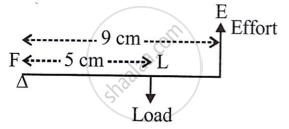
-
Mechanical advantage is
M.A. = `"effort arm"/"load arm" = (9 "cm")/(5 "cm")`
= 1.8
The relationship between MA, efficiency and V.R. is
M.A. = η × V.R.
V.R. = `(M.A)/η`V.R. = `(1.8 xx 100)/100`
V.R. = 1.8
-
When efficiency becomes 50%, i.e.,
`50/100 = 1/2`
M.A. < V.R.
Then V.R. will remain same 1.8
but its M.A. will become
M.A. = V.R. × η
M.A. = `(1.8 xx 50)/100 = 0.9`
APPEARS IN
संबंधित प्रश्न
What is a lever?
State the principle of a lever?
Give three examples for leavers of second order.
Which class of lever found in the human body is being used by a boy when he raises the weight of his body on his toes?
The following belong to which class of lever?
Human-arm
When we want to use a machine as a force multiplier, which class of lever should we preferably use? Give a simple diagram of such a lever.
What is a lever?
State the types (or kinds) of lever, and give two examples of each kind.
The length of a nut-cracker is 12 cm. A nut, when kept at a distance of 4 cm from its fulcrum, requires an effort of 100 gf to crack it. What force will be required to crack the nut without using the nut-cracker?
A crowbar of length 100 cm is used to lift a load of 5 kgf. It has its fulcrum at a distance of 20 cm from the load. Calculate:
(i) the mechanical advantage of a crowbar and,
(ii) the effort applied at the other end.
