Advertisements
Advertisements
प्रश्न
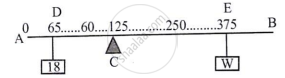
A 4 m long rod of negligible weight is to be balanced about a point 125 cm from one end and a load of 18 kgf is suspended at a point 60 cm from the support on the shorter arm.
- If a weight W is placed at a distance of 250 cm from the support on the longer arm to balance the rod, find W.
- If a weight 5 kgf is kept to balance the rod, find its position.
- To which class of lever does it belong?
Advertisements
उत्तर
(a) W × CE = 18 × DC
W × 250 = 18 × 60
∴ W = `(18 xx 60)/250`
∴ W = 4.32 kgf
(b) New W = 5 kgf
Let it be placed at a distance x from C on arm CB
∴ 5 × x = 18 × 60
∴ x = `(18 xx 60)/5`
= 216 cm
(c) It belongs to class I lever.
APPEARS IN
संबंधित प्रश्न
Write down a relation expressing the mechanical advantage of a lever.
Draw a diagram of a lever which is always used as a force multiplier. How is the effort arm related to the load arm in such a lever?
Which type of levers have mechanical advantage always more than 1? Give reasons.
Which class of lever found in the human body is being used by a boy when he holds a load on the palm of his hand.
The following belong to which class of lever?
Human-arm
Draw a labelled sketch of a second class lever. Give one example of such a lever.
The diagram below shows a lever in use.

(i) To which class of lever does it belong?
(ii) If FA = 40 cm, AB = 60 cm, then find the mechanical advantage of the lever.
The length of a nut-cracker is 12 cm. A nut, when kept at a distance of 4 cm from its fulcrum, requires an effort of 100 gf to crack it. What force will be required to crack the nut without using the nut-cracker?
What is a first-order lever?
A lever is used to multiply the force.
