Advertisements
Advertisements
Question
A 4 m long rod of negligible weight is to be balanced about a point 125 cm from one end and a load of 18 kgf is suspended at a point 60 cm from the support on the shorter arm.
- If a weight W is placed at a distance of 250 cm from the support on the longer arm to balance the rod, find W.
- If a weight 5 kgf is kept to balance the rod, find its position.
- To which class of lever does it belong?
Advertisements
Solution
(a) W × CE = 18 × DC
W × 250 = 18 × 60
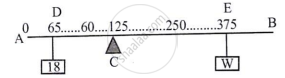
∴ W = `(18 xx 60)/250`
∴ W = 4.32 kgf
(b) New W = 5 kgf
Let it be placed at a distance x from C on arm CB
∴ 5 × x = 18 × 60
∴ x = `(18 xx 60)/5`
= 216 cm
(c) It belongs to class I lever.
APPEARS IN
RELATED QUESTIONS
Give one example of a class I lever where mechanical advantage is more than one ?
The following belong to which class of lever?
Human-arm
The following belong to which class of lever?
Pliers Tools
The following belong to which class of lever?
A claw-hammer
The following belong to which class of lever?
Wheelbarrow
The following are an example of levers. State the class of lever to which each one belongs giving the relative positions of Load (L), Effort (E), Fulcrum (F):
(i) Scissors (ii) Sugar tongs (iii) Nutcracker (iv) Pliers.
In the following diagram of a wheelbarrow, mark the fulcrum (F) and indicate the directions of load (L) and effort (E) with arrows.

What class of lever is it? Give one more example of the same class of lever.
What is a lever?
The length of a nut-cracker is 12 cm. A nut, when kept at a distance of 4 cm from its fulcrum, requires an effort of 100 gf to crack it. What force will be required to crack the nut without using the nut-cracker?
A lever is used to multiply the force.
