Advertisements
Advertisements
प्रश्न
A 4 m long rod of negligible weight is to be balanced about a point 125 cm from one end and a load of 18 kgf is suspended at a point 60 cm from the support on the shorter arm.
- If a weight W is placed at a distance of 250 cm from the support on the longer arm to balance the rod, find W.
- If a weight 5 kgf is kept to balance the rod, find its position.
- To which class of lever does it belong?
Advertisements
उत्तर
(a) W × CE = 18 × DC
W × 250 = 18 × 60
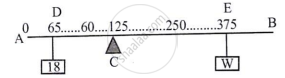
∴ W = `(18 xx 60)/250`
∴ W = 4.32 kgf
(b) New W = 5 kgf
Let it be placed at a distance x from C on arm CB
∴ 5 × x = 18 × 60
∴ x = `(18 xx 60)/5`
= 216 cm
(c) It belongs to class I lever.
APPEARS IN
संबंधित प्रश्न
What is a lever?
The lever for which the mechanical advantage is less than 1 has :
Class II levers are designed to have ______.
Which class of lever found in the human body is being used by a boy when he raises the weight of his body on his toes?
The following belong to which class of lever?
An oar of a boat
The following belong to which class of lever?
Wheelbarrow
Shears, used for cutting metals and scissors used for cutting clothes are both examples of levers of the first order. However, whereas the shears always have short blades and long handles, the scissors often have blades much longer than the handles. Explain, why this is so?
Draw a labelled sketch of a second class lever. Give one example of such a lever.
In the following diagram of a wheelbarrow, mark the fulcrum (F) and indicate the directions of load (L) and effort (E) with arrows.

What class of lever is it? Give one more example of the same class of lever.
A lever is used to multiply the force.
