हिंदी

The Following Belong to Which Class of Lever? an Oar of a Boat

Advertisements
Advertisements

प्रश्न

The following belong to which class of lever?

An oar of a boat

एक पंक्ति में उत्तर
Advertisements

उत्तर

Second-class of lever

shaalaa.com
  क्या इस प्रश्न या उत्तर में कोई त्रुटि है?

संबंधित प्रश्न

State the principle of a lever?


The lever for which the mechanical advantage is less than 1 has :


A man uses a crowbar of length 1.5 m to raise a load of 75 kgf by putting a sharp edge below the bar at a distance 1 m from his hand.

  1. Draw a diagram of the arrangement showing the fulcrum (F), load (L) and effort (E) with their directions.
  2. State the kind of lever.
  3. Calculate:
    1. load arm,
    2. effort arm,
    3. mechanical advantage and
    4. the effort needed.

The following belong to which class of lever?

A see-saw


The following are an example of levers. State the class of lever to which each one belongs giving the relative positions of Load (L), Effort (E), Fulcrum (F):
(i) Scissors (ii) Sugar tongs (iii) Nutcracker (iv) Pliers.


In the diagram shown alongside a claw hammer, mark the fulcrum (F) and indicate the directions of load (L) and effort (E) with arrows. What class of lever is it? Give one more example of this class of lever.


The diagram below shows a lever in use.


(i) To which class of lever does it belong?
(ii) If FA = 40 cm, AB = 60 cm, then find the mechanical advantage of the lever.


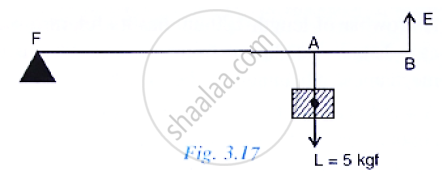
The diagram shows the use of a lever.

  1. State the principle of moments as applied to the above lever.
  2. Which class of lever is this? Give an example of this class of lever.
  3. If FA = 100 cm, AB = 90 cm, calculate the minimum effort required to lift the load.

The length of a nut-cracker is 12 cm. A nut, when kept at a distance of 4 cm from its fulcrum, requires an effort of 100 gf to crack it. What force will be required to crack the nut without using the nut-cracker?


A crowbar of length 100 cm is used to lift a load of 5 kgf. It has its fulcrum at a distance of 20 cm from the load. Calculate:
(i) the mechanical advantage of a crowbar and,
(ii) the effort applied at the other end.


Share
Notifications

Englishहिंदीमराठी


      Forgot password?
Use app×