Advertisements
Advertisements
प्रश्न
Fig 3.17 below shows a lever in use.
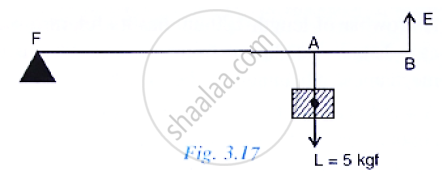
(a) To which class of lever does it belong?
(b) If FA = 80 cm, AB = 20 cm, find its mechanical advantage.
(c) Calculate the value of E.
Advertisements
उत्तर
(a) This is a class II lever.
(b) Given: FA=80 cm, AB = 20 cm, BF= FA+AB=100cm
Mechanical advantage M.A = `"𝐵𝐹"/"𝐴𝐹"`= `100/80` = 1.25
(c) Effort (E) = `"𝐿𝑜𝑎𝑑 (𝐿)"/"𝑀.𝐴"` = `5 /1.25` = 4 𝐾𝑔𝑓
संबंधित प्रश्न
Which class of lever will always have MA > 1 and why?
Name a machine to obtain gain in speed?
State the principle of a lever?
A lever of length 9 cm has its load arm 5 cm long and the effort arm is 9 cm long.
- To which class does it belong?
- Draw a diagram of the lever showing the position of fulcrum F and directions of both the load L and effort E.
- What is the mechanical advantage and velocity ratio if the efficiency is 100%?
- What will be the mechanical advantage and velocity ratio if the efficiency becomes 50%?
The following belong to which class of lever?
The Physical balance
The following belong to which class of lever?
A fire tongs
Shears, used for cutting metals and scissors used for cutting clothes are both examples of levers of the first order. However, whereas the shears always have short blades and long handles, the scissors often have blades much longer than the handles. Explain, why this is so?
Draw a labelled sketch of a second class lever. Give one example of such a lever.
In the following diagram of a wheelbarrow, mark the fulcrum (F) and indicate the directions of load (L) and effort (E) with arrows.

What class of lever is it? Give one more example of the same class of lever.
A crowbar of length 100 cm is used to lift a load of 5 kgf. It has its fulcrum at a distance of 20 cm from the load. Calculate:
(i) the mechanical advantage of a crowbar and,
(ii) the effort applied at the other end.
