Advertisements
Advertisements
प्रश्न
The diagram below shows a lever in use.

(i) To which class of lever does it belong?
(ii) If FA = 40 cm, AB = 60 cm, then find the mechanical advantage of the lever.
Advertisements
उत्तर
(i) Class 2 lever.
(ii) We know,
L × LA = E × EA.
M.A. =`"L"/"E"=("EA")/("LA")`
= `100/40`
= 2.5
संबंधित प्रश्न
Which class of lever will always have MA > 1 and why?
Write down a relation expressing the mechanical advantage of a lever.
shows a nut cracker name the class of lever ?
The lever for which the mechanical advantage is less than 1 has :
Fig 3.17 below shows a lever in use.
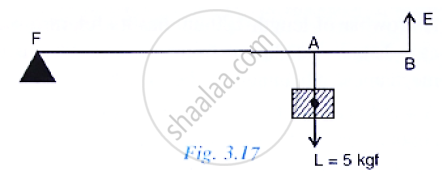
(a) To which class of lever does it belong?
(b) If FA = 80 cm, AB = 20 cm, find its mechanical advantage.
(c) Calculate the value of E.
Which type of levers have mechanical advantage always more than 1? Give reasons.
The following belong to which class of lever?
Pliers Tools
The following belong to which class of lever?
Rowing of a boat
The following belong to which class of lever?
A pair of scissors
The length of a nut-cracker is 12 cm. A nut, when kept at a distance of 4 cm from its fulcrum, requires an effort of 100 gf to crack it. What force will be required to crack the nut without using the nut-cracker?
