Advertisements
Advertisements
प्रश्न
What is a lever?
Advertisements
उत्तर
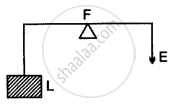
A lever is a special case of the application of the law of moments. It is a rigid bar, straight or bent, which is capable of rotation about a fixed point or a fixed-line, called the axis of rotation. This fixed point or the axis of rotation is called the fulcrum. An effort E is applied at point A of the lever to overcome resistance (or load) at another point B, as shown in the diagram.
संबंधित प्रश्न
Which class of lever will always have MA > 1 and why?
Name a machine to obtain gain in speed?
shows a nut cracker name the class of lever ?
Which class of lever found in the human body is being used by a boy when he raises the weight of his body on his toes?
The following belong to which class of lever?
Knife
Shears, used for cutting metals and scissors used for cutting clothes are both examples of levers of the first order. However, whereas the shears always have short blades and long handles, the scissors often have blades much longer than the handles. Explain, why this is so?
Draw a labelled sketch of a second class lever. Give one example of such a lever.
The length of a nut-cracker is 12 cm. A nut, when kept at a distance of 4 cm from its fulcrum, requires an effort of 100 gf to crack it. What force will be required to crack the nut without using the nut-cracker?
What is a first-order lever?
A lever is used to multiply the force.
