Advertisements
Advertisements
प्रश्न
What is a first-order lever?
Advertisements
उत्तर
When the fulcrum is between the effort and the load,
it is known as the Class I lever.
Example: scissors, pliers, seesaw.
APPEARS IN
संबंधित प्रश्न
The diagram below shows a lever in use:
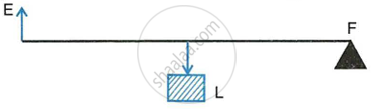
- To which class of levers does it belong?
- Without changing the dimensions of the lever, if the load is shifted towards the fulcrum what happens to the mechanical advantage of the lever?
Name a machine to obtain gain in speed?
What is a lever?
State the principle of a lever?
Class II levers are designed to have ______.
Give three examples for leavers of second order.
The following are an example of levers. State the class of lever to which each one belongs giving the relative positions of Load (L), Effort (E), Fulcrum (F):
(i) Scissors (ii) Sugar tongs (iii) Nutcracker (iv) Pliers.
Draw a labelled sketch of a second class lever. Give one example of such a lever.
In the following diagram of a wheelbarrow, mark the fulcrum (F) and indicate the directions of load (L) and effort (E) with arrows.

What class of lever is it? Give one more example of the same class of lever.
The diagram below shows a lever in use.

(i) To which class of lever does it belong?
(ii) If FA = 40 cm, AB = 60 cm, then find the mechanical advantage of the lever.
