Advertisements
Advertisements
प्रश्न
Class II levers are designed to have ______.
विकल्प
M.A. = V.R.
M.A. > V.R.
M.A. > 1
M.A. < 1
Advertisements
उत्तर
Class II levers are designed to have M.A. > 1.
Reason:
In class II levers, the load is in between the effort and fulcrum. Thus, the effort arm is always longer than the load arm and less effort is needed to overcome a large load. Hence, M.A > 1
संबंधित प्रश्न
What is a lever?
Draw a diagram of a lever which is always used as a force multiplier. How is the effort arm related to the load arm in such a lever?
Fig 3.17 below shows a lever in use.
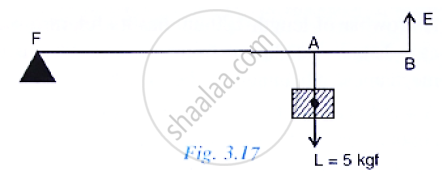
(a) To which class of lever does it belong?
(b) If FA = 80 cm, AB = 20 cm, find its mechanical advantage.
(c) Calculate the value of E.
A lever of length 9 cm has its load arm 5 cm long and the effort arm is 9 cm long.
- To which class does it belong?
- Draw a diagram of the lever showing the position of fulcrum F and directions of both the load L and effort E.
- What is the mechanical advantage and velocity ratio if the efficiency is 100%?
- What will be the mechanical advantage and velocity ratio if the efficiency becomes 50%?
The following belong to which class of lever?
An oar of a boat
The following belong to which class of lever?
Rowing of a boat
The following belong to which class of lever?
A pair of scissors
The following belong to which class of lever?
Wheelbarrow
The diagram shows the use of a lever.

- State the principle of moments as applied to the above lever.
- Which class of lever is this? Give an example of this class of lever.
- If FA = 100 cm, AB = 90 cm, calculate the minimum effort required to lift the load.
What is a first-order lever?
