Advertisements
Advertisements
Question
Class II levers are designed to have ______.
Options
M.A. = V.R.
M.A. > V.R.
M.A. > 1
M.A. < 1
Advertisements
Solution
Class II levers are designed to have M.A. > 1.
Reason:
In class II levers, the load is in between the effort and fulcrum. Thus, the effort arm is always longer than the load arm and less effort is needed to overcome a large load. Hence, M.A > 1
RELATED QUESTIONS
The diagram below shows a lever in use:
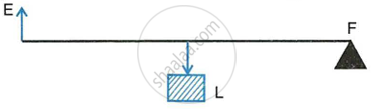
- To which class of levers does it belong?
- Without changing the dimensions of the lever, if the load is shifted towards the fulcrum what happens to the mechanical advantage of the lever?
What is a lever?
Write down a relation expressing the mechanical advantage of a lever.
Give one example of a class I lever where mechanical advantage is more than one ?
Give three examples for leavers of 1st order.
Which class of lever found in the human body is being used by a boy when he holds a load on the palm of his hand.
The following belong to which class of lever?
Human-arm
The following belong to which class of lever?
Pliers Tools
In the diagram shown alongside a claw hammer, mark the fulcrum (F) and indicate the directions of load (L) and effort (E) with arrows. What class of lever is it? Give one more example of this class of lever.

What is a lever?
