Advertisements
Advertisements
Question
The length of a nut-cracker is 12 cm. A nut, when kept at a distance of 4 cm from its fulcrum, requires an effort of 100 gf to crack it. What force will be required to crack the nut without using the nut-cracker?
Advertisements
Solution
Given : Effort arm = 12 cm, Load arm = 4 cm, Effort E = 100 gf, Load L = ?
(Nut-cracker is the lever of second order)
Since, `"Load"/"Effort"=("Effort arm")/("Load arm")`
∴ `"L"/100=12/4`
or L = 300 gf.
Thus, a force of 300 gf is required to crack the nut without using the nut-cracker.
RELATED QUESTIONS
Name a machine to obtain gain in speed?
Fig 3.17 below shows a lever in use.
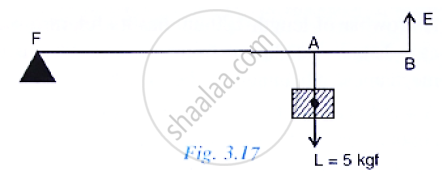
(a) To which class of lever does it belong?
(b) If FA = 80 cm, AB = 20 cm, find its mechanical advantage.
(c) Calculate the value of E.
A lever of length 9 cm has its load arm 5 cm long and the effort arm is 9 cm long.
- To which class does it belong?
- Draw a diagram of the lever showing the position of fulcrum F and directions of both the load L and effort E.
- What is the mechanical advantage and velocity ratio if the efficiency is 100%?
- What will be the mechanical advantage and velocity ratio if the efficiency becomes 50%?
Give three examples for leavers of the third order.
Which class of lever found in the human body is being used by a boy when he holds a load on the palm of his hand.
Which class of lever found in the human body is being used by a boy when he raises the weight of his body on his toes?
The following belong to which class of lever?
A see-saw
The following belong to which class of lever?
Wheelbarrow
Draw a labelled sketch of a second class lever. Give one example of such a lever.
In the following diagram of a wheelbarrow, mark the fulcrum (F) and indicate the directions of load (L) and effort (E) with arrows.

What class of lever is it? Give one more example of the same class of lever.
