Advertisements
Advertisements
Question
Fig 3.17 below shows a lever in use.
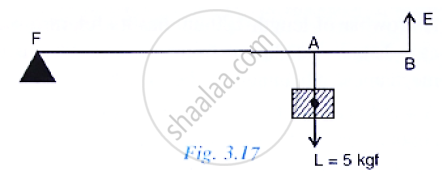
(a) To which class of lever does it belong?
(b) If FA = 80 cm, AB = 20 cm, find its mechanical advantage.
(c) Calculate the value of E.
Advertisements
Solution
(a) This is a class II lever.
(b) Given: FA=80 cm, AB = 20 cm, BF= FA+AB=100cm
Mechanical advantage M.A = `"𝐵𝐹"/"𝐴𝐹"`= `100/80` = 1.25
(c) Effort (E) = `"𝐿𝑜𝑎𝑑 (𝐿)"/"𝑀.𝐴"` = `5 /1.25` = 4 𝐾𝑔𝑓
RELATED QUESTIONS
The diagram below shows a lever in use:
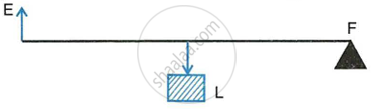
- To which class of levers does it belong?
- Without changing the dimensions of the lever, if the load is shifted towards the fulcrum what happens to the mechanical advantage of the lever?
A 4 m long rod of negligible weight is to be balanced about a point 125 cm from one end and a load of 18 kgf is suspended at a point 60 cm from the support on the shorter arm.
- If a weight W is placed at a distance of 250 cm from the support on the longer arm to balance the rod, find W.
- If a weight 5 kgf is kept to balance the rod, find its position.
- To which class of lever does it belong?
A lever of length 9 cm has its load arm 5 cm long and the effort arm is 9 cm long.
- To which class does it belong?
- Draw a diagram of the lever showing the position of fulcrum F and directions of both the load L and effort E.
- What is the mechanical advantage and velocity ratio if the efficiency is 100%?
- What will be the mechanical advantage and velocity ratio if the efficiency becomes 50%?
Give three examples for leavers of 1st order.
The following belong to which class of lever?
Pliers Tools
The following belong to which class of lever?
A fire tongs
The following belong to which class of lever?
Nutcracker
Draw a labelled sketch of a second class lever. Give one example of such a lever.
In the diagram shown alongside a claw hammer, mark the fulcrum (F) and indicate the directions of load (L) and effort (E) with arrows. What class of lever is it? Give one more example of this class of lever.

When we want to use a machine as a force multiplier, which class of lever should we preferably use? Give a simple diagram of such a lever.
