Advertisements
Advertisements
Question
Draw a diagram of a lever which is always used as a force multiplier. How is the effort arm related to the load arm in such a lever?
Advertisements
Solution
Because the effort arm of a Class II lever is longer than the load arm and the mechanical advantage is always greater than 1, the lever multiplies force.

APPEARS IN
RELATED QUESTIONS
Write down a relation expressing the mechanical advantage of a lever.
shows a nut cracker name the class of lever ?
Class II levers are designed to have ______.
Fig 3.17 below shows a lever in use.
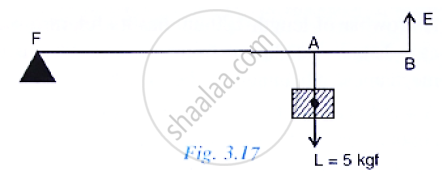
(a) To which class of lever does it belong?
(b) If FA = 80 cm, AB = 20 cm, find its mechanical advantage.
(c) Calculate the value of E.
The following belong to which class of lever?
An oar of a boat
Draw a labelled sketch of a second class lever. Give one example of such a lever.
In the diagram shown alongside a claw hammer, mark the fulcrum (F) and indicate the directions of load (L) and effort (E) with arrows. What class of lever is it? Give one more example of this class of lever.

In the following diagram of a wheelbarrow, mark the fulcrum (F) and indicate the directions of load (L) and effort (E) with arrows.

What class of lever is it? Give one more example of the same class of lever.
The diagram below shows a lever in use.

(i) To which class of lever does it belong?
(ii) If FA = 40 cm, AB = 60 cm, then find the mechanical advantage of the lever.
What is a lever?
