Advertisements
Advertisements
प्रश्न
State the types (or kinds) of lever, and give two examples of each kind.
Advertisements
उत्तर
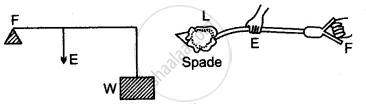
There are three kinds of the lever, depending upon the different positions of the load, fulcrum and the effort.
Type I: When fulcrum is in the middle.
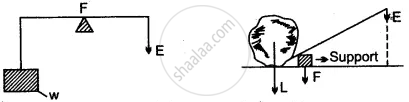
Type II: When the load is between the fulcrum and the effort.

Type III: When the effort lies between the fulcrum and load.
संबंधित प्रश्न
Write down a relation expressing the mechanical advantage of a lever.
Class II levers are designed to have ______.
A man uses a crowbar of length 1.5 m to raise a load of 75 kgf by putting a sharp edge below the bar at a distance 1 m from his hand.
- Draw a diagram of the arrangement showing the fulcrum (F), load (L) and effort (E) with their directions.
- State the kind of lever.
- Calculate:
- load arm,
- effort arm,
- mechanical advantage and
- the effort needed.
Which type of levers have mechanical advantage always more than 1? Give reasons.
Give three examples for leavers of the third order.
Which class of lever found in the human body is being used by a boy when he raises the weight of his body on his toes?
The following belong to which class of lever?
The Physical balance
The following belong to which class of lever?
Wheelbarrow
The following are an example of levers. State the class of lever to which each one belongs giving the relative positions of Load (L), Effort (E), Fulcrum (F):
(i) Scissors (ii) Sugar tongs (iii) Nutcracker (iv) Pliers.
The diagram below shows a lever in use.

(i) To which class of lever does it belong?
(ii) If FA = 40 cm, AB = 60 cm, then find the mechanical advantage of the lever.
