Advertisements
Advertisements
प्रश्न
A man uses a crowbar of length 1.5 m to raise a load of 75 kgf by putting a sharp edge below the bar at a distance 1 m from his hand.
- Draw a diagram of the arrangement showing the fulcrum (F), load (L) and effort (E) with their directions.
- State the kind of lever.
- Calculate:
- load arm,
- effort arm,
- mechanical advantage and
- the effort needed.
Advertisements
उत्तर
(a)
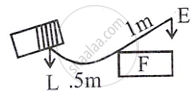
75 kgf. crow bar
Effort = ?
M.A. = `"L"/"E"`
2 = `("75 kgf")/"E"`
E = `75/2`
E = 37.5 kgf
(b) Class I lever
(c)
- Load arm 1.5 – 1.0 = 0.5 m
- Effort arm = 1 m
- Mechanical advantage = `1.0/0.5 = 2`
APPEARS IN
संबंधित प्रश्न
The lever for which the mechanical advantage is less than 1 has :
Give three examples for leavers of the third order.
Which class of lever found in the human body is being used by a boy when he holds a load on the palm of his hand.
The following belong to which class of lever?
An oar of a boat
The following belong to which class of lever?
Human-arm
The following belong to which class of lever?
A fire tongs
The following belong to which class of lever?
Sugar tongs
When we want to use a machine as a force multiplier, which class of lever should we preferably use? Give a simple diagram of such a lever.
What is a lever?
State the types (or kinds) of lever, and give two examples of each kind.
