Advertisements
Advertisements
प्रश्न
When we want to use a machine as a force multiplier, which class of lever should we preferably use? Give a simple diagram of such a lever.
To use a machine as a force multiplier, what class of lever should be preferred? Draw a sketch of such a lever.
Advertisements
उत्तर

Though we can use either first class of lever or second class of lever, for multiplying force, we should preferably use a second class of lever. This is because the mechanical advantage of the second class of lever is always greater than one. A simple diagram of the second class of lever is shown alongside. The wheelbarrow, the bottle opener, and the mango cutter are some of the practical forms of the second class of lever.
APPEARS IN
संबंधित प्रश्न
The diagram below shows a lever in use:
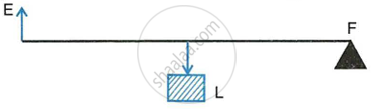
- To which class of levers does it belong?
- Without changing the dimensions of the lever, if the load is shifted towards the fulcrum what happens to the mechanical advantage of the lever?
Name a machine to obtain gain in speed?
Write down a relation expressing the mechanical advantage of a lever.
The lever for which the mechanical advantage is less than 1 has :
Which type of levers have mechanical advantage always more than 1? Give reasons.
The following belong to which class of lever?
Knife
The following belong to which class of lever?
Fore-arm
In the following diagram of a wheelbarrow, mark the fulcrum (F) and indicate the directions of load (L) and effort (E) with arrows.

What class of lever is it? Give one more example of the same class of lever.
What is a lever?
A crowbar of length 100 cm is used to lift a load of 5 kgf. It has its fulcrum at a distance of 20 cm from the load. Calculate:
(i) the mechanical advantage of a crowbar and,
(ii) the effort applied at the other end.
