Advertisements
Advertisements
प्रश्न
A plane electromagnetic wave travels in the vacuum along the z-direction. What can you say about the directions of its electric and magnetic field vectors? If the frequency of the wave is 30 MHz, what is its wavelength?
If the frequency of an electromagnetic wave travelling in a vacuum in the z-direction is 30 MHz, calculate its wavelength. Consider the speed of the wave as 3 × 10⁸ m/s.
Advertisements
उत्तर
The electromagnetic wave travels in a vacuum along the z-direction. The electric field (E) and the magnetic field (H) are in the x-y plane and mutually perpendicular.
Frequency of the wave, v = 30 MHz = 30 × 106 s−1
Speed of light in a vacuum, c = 3 × 10⁸ m/s
Wavelength of a wave is given as:
`lambda = "c"/"v"`
= `(3 xx 10^8)/(30 xx 10^6)`
= 10 m
APPEARS IN
संबंधित प्रश्न
Identify the part of the electromagnetic spectrum which is:
produced by bombarding a metal target by high speed electrons.
A wave has wavelength 50 Å.
- Name the wave.
- State its speed in vacuum.
- State its one use.
Arrange the following radiations in the order of their increasing wavelength:
X-rays, infrared rays, ratio waves, gamma ray and microwaves.
An electromagnetic wave has a frequency of 500 MHz and a wavelength of 60 cm Calculate the velocity of the wave.
Name of physical quantity which remains same for microwaves of wavelength 1 mm and UV radiations of 1600 Å in vacuum.
One of the following wavelengths is absent and the rest are present in the X-rays coming from a Coolidge tube. Which one is the absent wavelength?
X-ray from a Coolidge tube is incident on a thin aluminium foil. The intensity of the X-ray transmitted by the foil is found to be I0. The heating current is increased to increase the temperature of the filament. The intensity of the X-ray transmitted by the foil will be
(a) zero
(b) < I0
(c) I0
(d) > I0
The potential difference applied to an X-ray tube is increased. As a result, in the emitted radiation,
(a) the intensity increases
(b) the minimum wavelength increases
(c) the intensity remains unchanged
(d) the minimum wavelength decreases.
If the operating potential in an X-ray tube is increased by 1%, by what percentage does the cutoff wavelength decrease?
(Use Planck constant h = 6.63 × 10⁻³⁴ Js= 4.14 × 10⁻¹⁵ eVs, speed of light c = 3 × 10⁸ m/s.)
The stopping potential in a photoelectric experiment is linearly related to the inverse of the wavelength (1/λ) of the light falling on the cathode. The potential difference applied across an X-ray tube is linearly related to the inverse of the cutoff wavelength (1/λ) of the X-ray emitted. Show that the slopes of the lines in the two cases are equal and find its value.
(Use Planck constant h = 6.63 × 10⁻³⁴ Js= 4.14 × 10⁻¹⁵ eVs, speed of light c = 3 × 10⁸ m/s.)
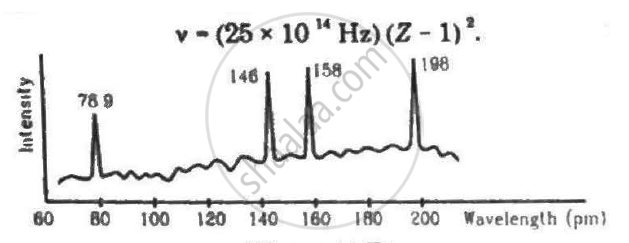
Continuous X-rays are made to strike a tissue paper soaked with polluted water. The incoming X-rays excite the atoms of the sample by knocking out the electrons from the inner shells. Characteristic X-rays are analysed and the intensity is plotted against the wavelength. Assuming that only Kα intensities are detected, list the elements present in the sample from the plot. Use Moseley's equation v − (25 × 1014Hz)(Z − 1)2.
(Use Planck constant h = 6.63 × 10⁻³⁴ Js= 4.14 × 10⁻¹⁵ eVs, speed of light c = 3 × 10⁸ m/s.)
Define the term "Intensity" in the photon picture of electromagnetic radiation.
Give one use of electromagnetic radiation in Microwaves.
Choose the correct option.
The EM wave emitted by the Sun and responsible for heating the Earth’s atmosphere due to greenhouse effect is
What are the ultraviolet rays?
Answer briefly.
Name the most harmful radiation entering the Earth's atmosphere from outer space.
Solve the numerical problem.
Calculate the frequency in MHz of a radio wave of wavelength 250 m. Remember that the speed of all EM waves in a vacuum is 3.0 × 10⁸ m/s.
Solve the numerical problem.
The speed of light is 3 × 10⁸ m/s. Calculate the frequency of red light of a wavelength of 6.5 × 10⁻⁷ m.
An e.m. wave exerts pressure on the surface on which it is incident. Justify.
Which of the following is a tool used for separating the different color wavelengths from each other?
For television broadcasting, the frequency employed is normally
The frequency of x-rays, y-rays and ultraviolet rays are respectively a, b and c. Then:-
Ozone layer above the earth's atmosphere will
If λv, λx and λm Am represents the wavelength of visible light, x-ray and microwaves respectively, then ______.
Why does microwave oven heats up a food item containing water molecules most efficiently?
In uranium (Z = 92) the K absorption edge is 0.107 Å and the Kα line is 0.126 Å, and the wavelength of the L absorption edge is ______.
Choose the correct option related to wavelengths (λ) of different parts of the electromagnetic spectrum.
Identify the part of the electromagnetic spectrum which:
- produces the heating effect.
- is absorbed by the ozone layer in the atmosphere.
- is used for studying crystal structure.
Write any one method of the production of each of the above radiations.
What is the speed of radio waves in vacuum?
