Advertisements
Advertisements
प्रश्न
The wavelengths for the light of red and blue colours are roughly 7.8 × `10^7` m and 4.8 × `10^7` m respectively.
(a) Which colour has the greater speed in vacuum?
(b) Which colour has the greater speed in glass?
Advertisements
उत्तर
(a) In vacuum, both have the same speeds.
(b) In a glass, red light has greater speed.
संबंधित प्रश्न
Name the parts of the electromagnetic spectrum which is
used as a diagnostic tool in medicine.
Write in brief, how these waves can be produced.
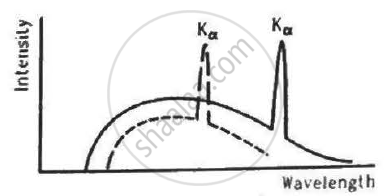
The figure shows the intensity-wavelength relations of X-rays coming from two different Coolidge tubes. The solid curve represents the relation for the tube A in which the potential difference between the target and the filament is VA and the atomic number of the target material is ZA. These quantities are VB and ZB for the other tube. Then,
The X-ray coming from a Coolidge tube has a cutoff wavelength of 80 pm. Find the kinetic energy of the electrons hitting the target.
(Use Planck constant h = 6.63 × 10⁻³⁴ Js= 4.14 × 10⁻¹⁵ eVs, speed of light c = 3 × 10⁸ m/s.)
The Kβ X-ray of argon has a wavelength of 0.36 nm. The minimum energy needed to ionize an argon atom is 16 eV. Find the energy needed to knock out an electron from the K shell of an argon atom.
A free atom of iron emits Kα X-rays of energy 6.4 keV. Calculate the recoil kinetic energy of the atom. Mass of an iron atom = 9.3 × 10⁻²⁶ kg.
(Use Planck constant h = 6.63 × 10⁻³⁴ Js= 4.14 × 10⁻¹⁵ eVs, speed of light c = 3 × 10⁸ m/s.)
Give one use of electromagnetic radiation in Microwaves.
What is the wavelength of the wave whose frequency is 1012 Hz? Name the electromagnetic wave.
Choose the correct option.
Earth’s atmosphere is richest in
Identify the electromagnetic radiation and write its wavelength range, which is used to kill germs in water purified. Name the two sources of these radiations.
What do electromagnetic waves require for propagation?
