Advertisements
Advertisements
प्रश्न
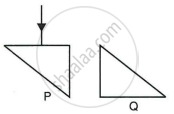
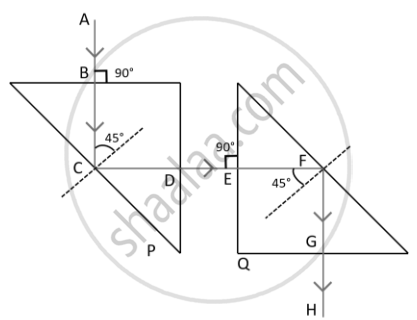
Two isosceles right-angle glass prisms P and Q are placed near each other as shown in Fig. Complete the path of the light ray entering the prism P till it emerges out of the prism Q.
Advertisements
उत्तर
संबंधित प्रश्न
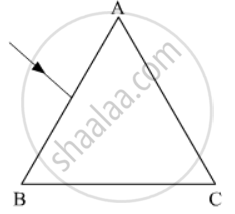
The figure shows a ray of light falling normally on the face AB of an equilateral glass prism having refractive index`3/2`, placed in water of refractive index `4/3`.Will this ray suffer total internal reflection on striking the face AC? Justify your answer.
State two conditions necessary for total internal reflection to occur.
How does a ray of light bend when it travels from rarer to denser medium
How are critical angles related to the refractive index of the medium?
A ray of light incident at an angle of incidence ‘i’ passes through an equilateral glass prism such that the refracted ray inside the prism is parallel to its base and emerges from the prism at an angle of emergence ‘e’.
How is the angle of emergence ‘e’ related to the angle of incidence ‘i’?
Answer the following question.
Define the critical angle of incidence and obtain an expression for it.
For the same angle of incidence, the angle of refraction in four media A, B, C and D are 25°, 30°, 35° and 40° respectively. The speed of light is least in medium ______.
The critical angle is defined as the angle of incidence at which the total internal reflection starts to occur.
- Assertion (A): Propagation of light through an optical fibre is due to total internal reflection taking place at the core-cladding interface.
- Reason (R): Refractive index of the material of the cladding of the optical fibre is greater than that of the core.
Small air bubbles rising up a fish tank appear silvery when viewed from some particular angle is due to the ______.
