Advertisements
Advertisements
प्रश्न
Draw diagram to illustrate the total internal reflection.
Advertisements
उत्तर
When the incidence angle is greater than the critical angle, i.e., in the case of total internal reflection.

APPEARS IN
संबंधित प्रश्न
The diagram below shows a point source P inside a water container. Four rays A, B, C, D starting from the source P, are shown up to the water surface.
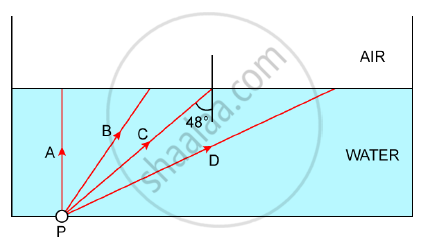
- Show in the diagram the path of these rays after striking the water surface. The Critical Angle for the water-air surface is 48°.
- Name the phenomenon which the rays B and D exhibit.
State the relation between the critical angle and the absolute refractive index of a medium.
Total internal reflection occurs only when a ray of light passes from a ______ medium to a ______ medium.
Can light be ‘piped’ like sound in a doctor’s stethoscope?
What is meant by the statement, ‘the critical angle for diamond is 24°’?
The adjacent diagram shows two right-angled isosceles prisms A and B. Complete the diagram to show the path of rays P and Q emerging out of the prism B. What principles have you used to complete the diagram?

The resultant `vec"R"` of `vec"P"` and `vec"Q"` is perpendicular to `vec"P"`. Also `|vec"P"|=|vec"R"|`. The angle between `vec"P"` and `vec"Q"` is ______.
[tan 45° = 1]
A bundle of glass threads, each of which is capable of transmitting messages using light waves is called ______.
Which of the following is used in optical fibres?
Small air bubbles rising up a fish tank appear silvery when viewed from some particular angle is due to the ______.
