Advertisements
Advertisements
प्रश्न
A myopic adult has a far point at 0.1 m. His power of accomodation is 4 diopters.
- What power lenses are required to see distant objects?
- What is his near point without glasses?
- What is his near point with glasses? (Take the image distance from the lens of the eye to the retina to be 2 cm.)
Advertisements
उत्तर
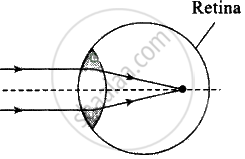
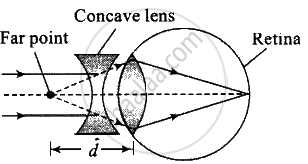
![]() (a) Defected eye |
![]() (b) Removal of Defect |
`1/f = 1/f_1 + 1/f_2`
In terms of power P = P1 + P2
i. If for the normal relaxed eye of an average person, the power at the far point be `P_f`. The required power
`P_f = 1/f = 1/0.1 + 1/0.2` = 60 D
By the corrective lens the object distance at the far point is `oo`
The power required is `P_f^' = 1/f^' = 1/(oo) + 1/0.02` = 50 D
Now for eye + lens system, we have the sum of the eye and that of the glasses `P_g`
`P_f^' = P_f + P_g` ⇒ 50 D = 60 D + `P_g`
Which gives, `P_g` = – 10 D
ii. For the normal eye his power of accommodation is 4 D, Let the power of the normal eye for near vision be `P_n`.
Then, 4 = `P_n = P_f` or `P_n` = 64 D
Let his near point be `x_n`, then
`1/x_n + 1/0.02` = 64 to `1/x_n + 50` = 64
`1/x_n` = 14 ⇒ `x_n = 1/14 m` = 0.07 m
iii. With glasses `P_n^' = P_f^' + 4` = 54
54 = `1/x_n^' + 1/0.02 = 1/x_n^' + 50`
`1/x_n` = 14 ⇒ `x_n^' = 1/4 m` = 0.25 m
APPEARS IN
संबंधित प्रश्न
A virtual image, we always say, cannot be caught on a screen. Yet when we ‘see’ a virtual image, we are obviously bringing it on to the ‘screen’ (i.e., the retina) of our eye. Is there a contradiction?
For a normal eye, the far point is at infinity and the near point of distinct vision is about 25cm in front of the eye. The cornea of the eye provides a converging power of about 40 dioptres, and the least converging power of the eye-lens behind the cornea is about 20 dioptres. From this rough data estimate the range of accommodation (i.e., the range of converging power of the eye-lens) of a normal eye.
Does short-sightedness (myopia) or long-sightedness (hypermetropia) imply necessarily that the eye has partially lost its ability of accommodation? If not, what might cause these defects of vision?
A myopic person has been using spectacles of power −1.0 dioptre for distant vision. During old age, he also needs to use the separate reading glass of power + 2.0 dioptres. Explain what may have happened.
The angle subtended at the eye by an object is equal to the angle subtended at the eye by the virtual image produced by a magnifying glass. In what sense then does a magnifying glass provide angular magnification?
In viewing through a magnifying glass, one usually positions one’s eyes very close to the lens. Does angular magnification change if the eye is moved back?
A Cassegrain telescope uses two mirrors as shown in the figure. Such a telescope is built with the mirrors 20 mm apart. If the radius of curvature of the large mirror is 220 mm and the small mirror is 140 mm, where will the final image of an object at infinity be?

When objects at different distances are seen by the eye, which of the following remain constant?
The focal length of a normal eye-lens is about
A man wearing glasses of focal length +1 m cannot clearly see beyond 1 m
When we see an object, the image formed on the retina is
(a) real
(b) virtual
(c) erect
(d) inverted
Mark the correct options.
(a) If the far point goes ahead, the power of the divergent lens should be reduced.
(b) If the near point goes ahead, the power of the convergent lens should be reduced.
(c) If the far point is 1 m away from the eye, divergent lens should be used.
(d) If the near point is 1 m away from the eye, divergent lens should be used.
Can virtual image be formed on the retina in a seeing process?
A normal eye has retina 2 cm behind the eye-lens. What is the power of the eye-lens when the eye is (a) fully relaxed, (b) most strained?