Advertisements
Advertisements
Question
A myopic adult has a far point at 0.1 m. His power of accomodation is 4 diopters.
- What power lenses are required to see distant objects?
- What is his near point without glasses?
- What is his near point with glasses? (Take the image distance from the lens of the eye to the retina to be 2 cm.)
Advertisements
Solution
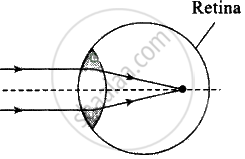 (a) Defected eye |
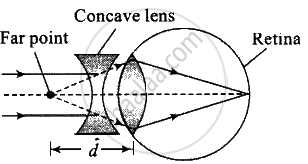 (b) Removal of Defect |
`1/f = 1/f_1 + 1/f_2`
In terms of power P = P1 + P2
i. If for the normal relaxed eye of an average person, the power at the far point be `P_f`. The required power
`P_f = 1/f = 1/0.1 + 1/0.2` = 60 D
By the corrective lens the object distance at the far point is `oo`
The power required is `P_f^' = 1/f^' = 1/(oo) + 1/0.02` = 50 D
Now for eye + lens system, we have the sum of the eye and that of the glasses `P_g`
`P_f^' = P_f + P_g` ⇒ 50 D = 60 D + `P_g`
Which gives, `P_g` = – 10 D
ii. For the normal eye his power of accommodation is 4 D, Let the power of the normal eye for near vision be `P_n`.
Then, 4 = `P_n = P_f` or `P_n` = 64 D
Let his near point be `x_n`, then
`1/x_n + 1/0.02` = 64 to `1/x_n + 50` = 64
`1/x_n` = 14 ⇒ `x_n = 1/14 m` = 0.07 m
iii. With glasses `P_n^' = P_f^' + 4` = 54
54 = `1/x_n^' + 1/0.02 = 1/x_n^' + 50`
`1/x_n` = 14 ⇒ `x_n^' = 1/4 m` = 0.25 m
