Advertisements
Advertisements
Question
The diagram below shows a point source P inside a water container. Four rays A, B, C, D starting from the source P are shown up to the water surface
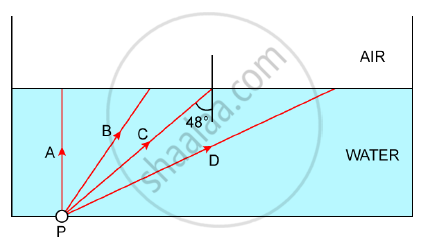
1) Show in the diagram the path of these rays after striking the water surface.
The Critical Angle for the water-air surface is 48°.
2) Name the phenomenon which the rays B and D exhibit.
Advertisements
Solution
1) Path of the rays after striking the water surface is shown below:

2) Ray 'B' and ray 'D' exhibit the phenomenon of reflection and total internal reflection (TIR), respectively.
APPEARS IN
RELATED QUESTIONS
Name the factors affecting the critical angle for the pair of media.
Angle of deviation is the angle which the ______ ray makes with the direction of ______ray.
Prove the statement.
A rainbow is the combined effect of the refraction, dispersion, and total internal reflection of light.
Make the correct choices for each of the following :
Total Internal reflection takes place when
(where ∠i = angle of incidence, ∠r = angle of refraction, ∠C = critical angle)
A ray of light incident at an angle of incidence ‘i’ passes through an equilateral glass prism such that the refracted ray inside the prism is parallel to its base and emerges from the prism at an angle of emergence ‘e’.
How is the angle of emergence ‘e’ related to the angle of incidence ‘i’?
The diagram shows a point source P inside a water container. Three rays A, B, and C starting from P are shown up to the water surface. Show in the diagram the path of these rays after striking the water surface. The critical angle for the water-air pair is 48°.

Explain ‘mirage’ as an illustration of refraction.
For total internal reflection to take place, the angle of inddence i and the refractive index µ of the medium must satisfy the inequality ____________.
Total internal reflection can take place only if light is travelling from ______.
A ray of light incident at an angle θ on a refracting face of a prism emerges from the other face normally. If the angle of the prism is 5° and the prism is made of a material of refractive index 1.5, the angle of incidence is ______.
