Advertisements
Advertisements
प्रश्न
The diagram below shows a point source P inside a water container. Four rays A, B, C, D starting from the source P are shown up to the water surface
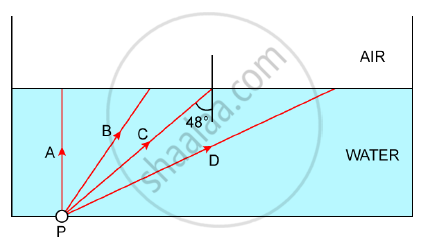
1) Show in the diagram the path of these rays after striking the water surface.
The Critical Angle for the water-air surface is 48°.
2) Name the phenomenon which the rays B and D exhibit.
Advertisements
उत्तर
1) Path of the rays after striking the water surface is shown below:

2) Ray 'B' and ray 'D' exhibit the phenomenon of reflection and total internal reflection (TIR), respectively.
APPEARS IN
संबंधित प्रश्न
Prove the statement.
A rainbow is the combined effect of the refraction, dispersion, and total internal reflection of light.
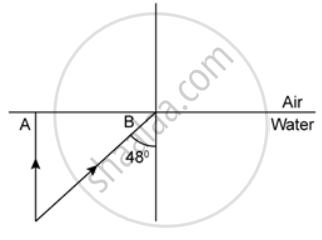
In the following figure, show two rays A and B travelling from water to air. If the critical angle for water- air surface is 48°, complete the ray diagram showing the refracted rays for each. State conditions when the ray will suffer total internal reflection.
Draw a diagram, properly labelled, to illustrate the use of a total reflecting prism (a right-angled isosceles prism) to turn a ray of light through 180°. Name an instrument in which this device is used.
PQ and PR are two light rays emerging from the object as shown in the figure below:

(i) What is the special name given to the angle of incidence (∠PQN) of ray PQ?
(ii) Copy the ray diagram and complete it to show the position of the image of the object P when seen obliquely from above.
(iii) Name the phenomenon that occurs if the angle of incidence ∠PQN is increased still further.
A ray of light is incident on a glass surface at an angle of 50° with the corresponding angle of refraction 30°. Find the value of the R.I. of glass.
Solve Numerical example.
A monochromatic ray of light is incident at 37° on an equilateral prism of refractive index 3/2. Determine angle of emergence and angle of deviation. If angle of prism is adjustable, what should its value be for emergent rays to be just possible for the same angle of incidence?
For total internal reflection to take place, the angle of inddence i and the refractive index µ of the medium must satisfy the inequality ____________.
A particle is projected such that the horizontal range and vertical height are equal. Then the angle of projection is :
What are the examples of total internal reflection in nature?
