Advertisements
Advertisements
प्रश्न
The diagram below shows a point source P inside a water container. Four rays A, B, C, D starting from the source P are shown up to the water surface
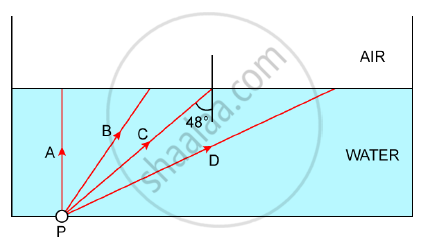
1) Show in the diagram the path of these rays after striking the water surface.
The Critical Angle for the water-air surface is 48°.
2) Name the phenomenon which the rays B and D exhibit.
Advertisements
उत्तर
1) Path of the rays after striking the water surface is shown below:

2) Ray 'B' and ray 'D' exhibit the phenomenon of reflection and total internal reflection (TIR), respectively.
APPEARS IN
संबंधित प्रश्न
Name the factors affecting the critical angle for the pair of media.
Solve the previous problem if the paperweight is inverted at its place so that the spherical surface touches the paper.
How does a ray of light bend when it travels from denser to rarer medium.
A ray of light incident at an angle of incidence ‘i’ passes through an equilateral glass prism such that the refracted ray inside the prism is parallel to its base and emerges from the prism at an angle of emergence ‘e’.
What can you say about the value of the angle of deviation in such a situation?
What is meant by the statement, ‘the critical angle for diamond is 24°’?
Choose the correct option.
Consider the following phenomena/ applications: P) Mirage, Q) rainbow, R) Optical fibre and S) glittering of a diamond. Total internal reflection is involved in
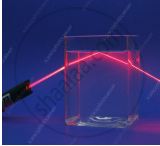
Observe the given figure and write appropriate phenomenon of light in the box.
A ray of light incident at an angle θ on a refracting face of a prism emerges from the other face normally. If the angle of the prism is 5° and the prism is made of a material of refractive index 1.5, the angle of incidence is ______.
State the condition under which total internal reflection occurs. Give the mathematical expression for total internal reflection.
Name any two phenomena which take place in the formation of a rainbow.
